Learn how an interview scoring rubric brings consistency to hiring, with templates, scales, implementation tips, and AI integration from Talent Pronto.
A qualified applicant leaves a panel interview with mixed signals. One interviewer writes, “Excellent communicator,” and gives a high rating. Another records, “Too theoretical,” and scores the same answer much lower. During the debrief, the louder voice persuades the group, the notes blur into impressions, and the hiring team makes a decision without a shared definition of what good performance looked like.
That's the problem an interview scoring rubric is designed to solve. It gives interviewers a common language for collecting evidence, rating observable behavior, and comparing candidates consistently. But a rubric can still fail after it's published, especially when several interviewers, group debriefs, automated screening, different accents, and different job families enter the process.
Consider a hiring manager recruiting a customer success lead. She asks about a difficult client relationship and hears a thoughtful answer with a clear resolution. She scores the candidate highly for ownership. A second interviewer hears the same answer but focuses on the candidate's limited detail about internal escalation. That interviewer gives a lower score for collaboration.
Neither interviewer is necessarily careless. They're using different mental yardsticks.
Without structure, one person may reward confidence, another may reward technical depth, and a third may react to conversational style. Unstructured notes make the problem worse because phrases such as “great energy,” “not strategic,” or “strong fit” rarely identify the behavior that produced the judgment. They also make later comparison difficult, since each interviewer captures different evidence in a different format.
Practical rule: If two interviewers can read the same answer and justify opposite ratings without violating the process, the rubric needs clearer anchors.
A structured interview rubric creates that shared standard. Instead of asking whether the candidate “felt senior,” the panel agrees in advance on what senior behavior looks like for the role. The interviewers then score the candidate against that evidence, not against personal preference.
That distinction matters for fairness and defensibility. Standardized questions, scoring procedures, and documentation give the employer a record of how candidates were evaluated. They also reduce the risk that a debrief becomes a contest of memory, charisma, or status.
The rubric isn't paperwork added after the interview. It's a shared measurement language used during the interview. When each interviewer records evidence against the same criteria, disagreement becomes visible and discussable instead of disappearing into a final consensus score.
Think of a recipe. It identifies the ingredients, explains the steps, and describes what the finished dish should look like. Without those details, two cooks can follow the same vague instruction and produce completely different results.
An interview scoring rubric works the same way. It defines what the interviewer should assess, what evidence counts, and how that evidence maps to a rating. Structured-interview rubric guidance describes the essential design as defined criteria, clear behavioral indicators, and a consistent rating scale, such as 1–5 or descriptive levels from below expectations to exceeds expectations.
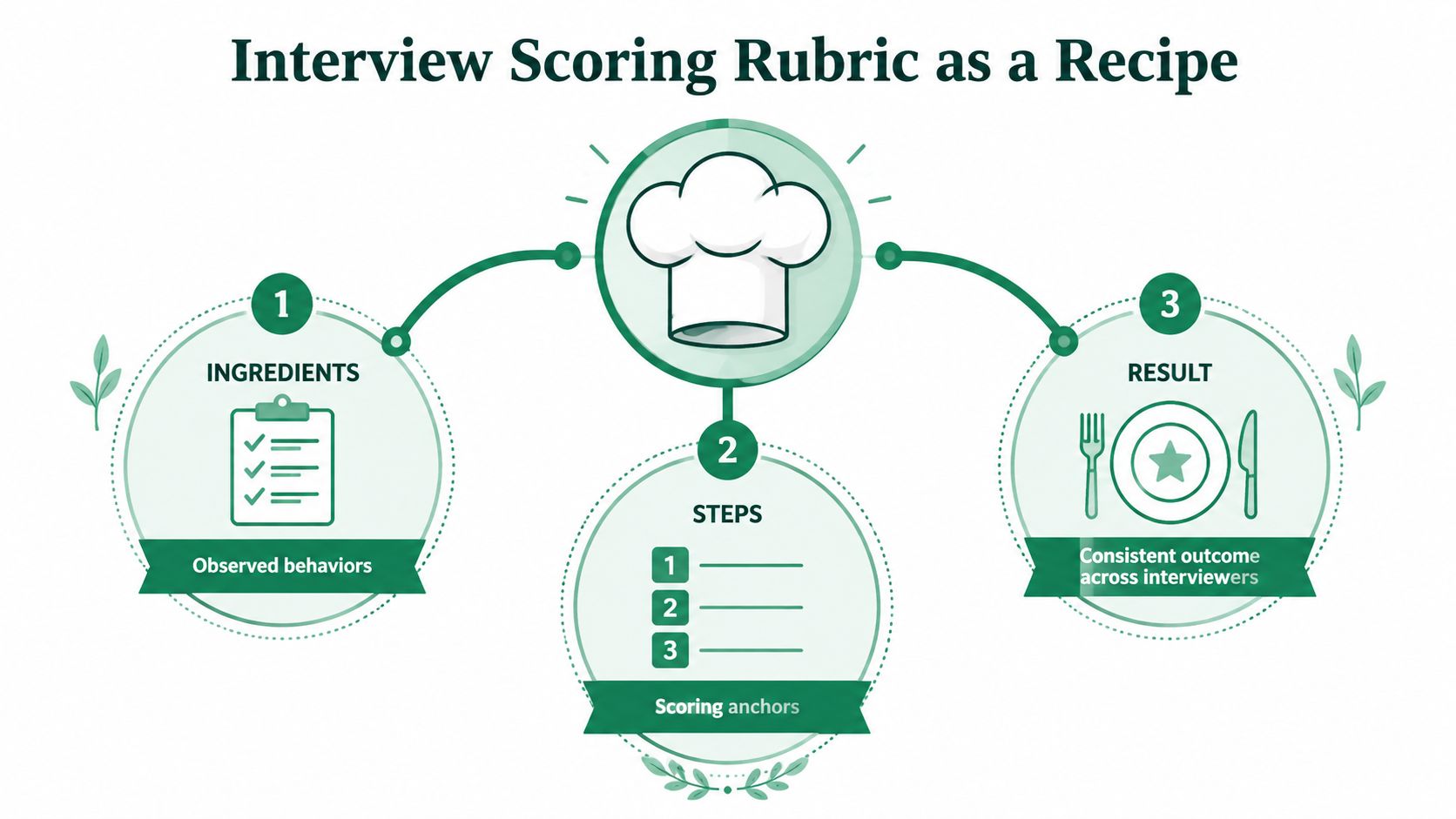
The ingredients are the criteria. For a support manager, they might include customer judgment, coaching, problem-solving, and operational ownership. For a software engineer, they might include debugging, system thinking, collaboration, and technical decision-making.
Criteria should connect directly to the role. A long list of company values usually creates noise. A useful rubric focuses on the capabilities the candidate must demonstrate in the job.
Behavioral indicators are the observable signs behind each criterion. “Communication” is too broad by itself. A stronger indicator might describe how the candidate explains a complex decision, adapts the explanation for different audiences, or handles disagreement with a stakeholder.
The indicator gives interviewers something concrete to listen for. It also helps candidates receive the same opportunity to demonstrate relevant behavior.
The rating scale translates evidence into a consistent judgment. A numeric scale can work, but the number alone has no meaning. Each level needs a description, such as an incomplete example, a partially effective response, or a detailed example that shows sound judgment and a measurable outcome.
A rubric is therefore more than a scorecard form. It's a measurement instrument. The criteria are the ingredients, the behavioral indicators are the doneness cues, and the scale is the shared method for describing the result.
A defensible structured interview depends on process consistency as much as wording. HR guidance on building a legally defensible structured-interview process recommends asking the same core questions in the same order, applying the same scoring procedures, and documenting evaluations.
That structure doesn't eliminate judgment. It makes judgment easier to inspect.
The recommended question mix includes 8–12 core behavioral or situational questions, plus 2–3 role-specific technical questions, according to the same guidance. The core questions create a consistent foundation across candidates, while the technical questions allow the panel to test job-specific capability.
Behavioral questions ask candidates to describe what they did in a real situation. Situational questions ask how they'd approach a defined challenge. Technical questions test role-linked knowledge or application. Each question should map to one or more criteria, and each criterion should have enough opportunities for the candidate to provide evidence.
A simple design table can keep the relationship visible:
| Question type | What it tests | What the interviewer records |
|---|---|---|
| Behavioral | Past actions and judgment | Situation, action, and result |
| Situational | Approach to a defined challenge | Reasoning, trade-offs, and priorities |
| Technical | Role-specific capability | Method, accuracy, and application |
The guidance supports 1–5 or 1–7 scales, with each level anchored by behavioral examples. A high rating shouldn't mean “I liked the answer.” It should mean the answer demonstrated the behaviors associated with that level.
Documentation completes the design. Interviewers should record the evidence supporting a rating, not only the rating itself. If a decision is later questioned, the organization can show the question asked, the criteria assessed, the evidence captured, and the procedure used.
Fairness review also belongs in the design conversation. Teams assessing selection outcomes can use this adverse impact overview to understand why consistent criteria and documented evaluation matter beyond the interview room.
A shallow scale asks, “How did this candidate do from 1 to 5?” A useful scale asks, “What did the candidate demonstrate, and which rating description matches that evidence?”
Both may display five numbers. Only one gives interviewers a reliable standard.
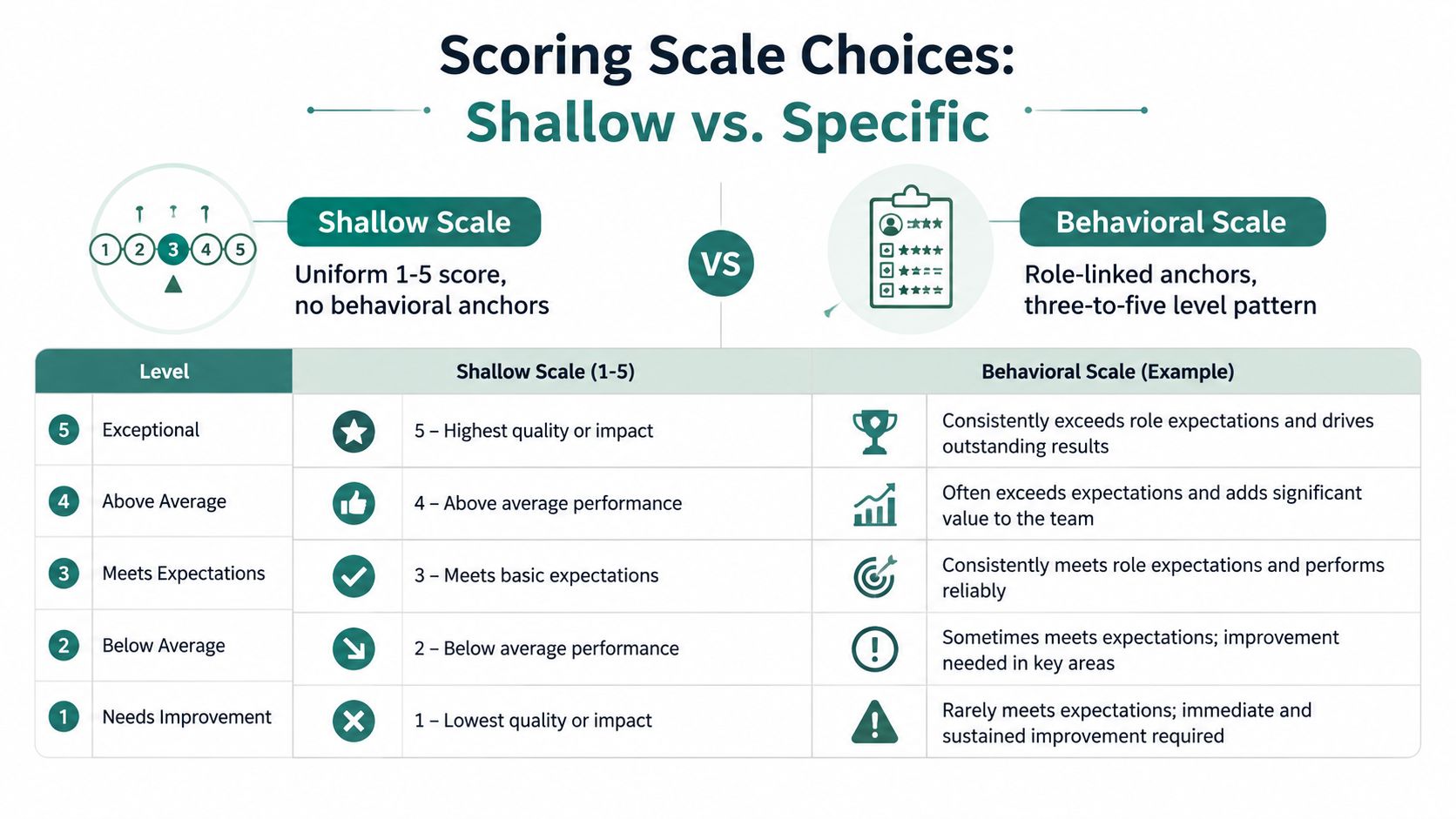
A uniform scale with no anchors invites personal interpretation:
| Rating | Shallow wording | Why it fails |
|---|---|---|
| 1 | Poor | Doesn't identify the missing behavior |
| 3 | Average | Encourages safe middle scores |
| 5 | Excellent | Rewards overall impression |
A behaviorally anchored scale ties each level to the role:
| Rating | Example anchor for stakeholder management |
|---|---|
| 1 | Doesn't identify the stakeholder's concern or propose a workable response |
| 3 | Identifies the concern and suggests a reasonable response, but provides limited evidence of follow-through |
| 5 | Diagnoses competing needs, explains the trade-off, aligns stakeholders, and shows how the decision produced a clear outcome |
The exact wording should change by role. A technical support role may emphasize diagnosis and escalation. A warehouse supervisor role may emphasize safety, prioritization, and team coordination. A compliance role may require evidence of documentation and adherence to defined procedures.
A common design pattern is to use three to five rating levels for each question and attach a short evidence note to every score. The note might contain a quote, behavior, or outcome, creating a more auditable record and supporting consistent comparison across candidates, as described in this structured interview checklist.
Use a simple template:
For practical note-taking structure, teams can adapt an interview notes template so evidence stays connected to the score rather than scattered across documents.
A rubric becomes useful when interviewers can apply it without slowing the conversation. Start with one role, one panel, and a small set of questions. Ask the panel to review the criteria before interviews begin and discuss what each anchor means in practice.
Choose a role where inconsistent evaluation is already visible. Run the rubric through real interviews, then inspect whether interviewers can find evidence for every criterion. If a question repeatedly produces opinions instead of observable behavior, rewrite the question or its anchors.
Training should include practice answers. Give interviewers the same sample response and ask them to score independently. Compare the ratings, identify the wording that caused disagreement, and revise the anchor until the panel can explain the difference between levels.
New interviewers also need instruction on separating evidence from interpretation. “Candidate seemed nervous” describes an impression. “Candidate changed the proposed approach after identifying a customer constraint” describes behavior. The second note supports a more consistent rating.
Teams building interviewer capability can use a structured interviewer training resource alongside role-specific calibration exercises.

Each interviewer should submit an initial score and evidence note before the group debrief. This preserves the independent signal and shows where the panel disagrees.
Only then should the group discuss the evidence. The purpose of calibration isn't to force everyone into the same score. It's to determine whether the rubric, the question, or the evidence was unclear.
Keep a record of recurring disagreements. If interviewers repeatedly split on the same criterion, update the anchor or provide another practice example. A short review after the pilot can prevent a flawed rubric from spreading across every hiring panel.
A written rubric doesn't stay reliable automatically. Once several interviewers score candidates, discuss impressions, and use automated tools, the organization needs to test whether the rubric still measures the intended behaviors.
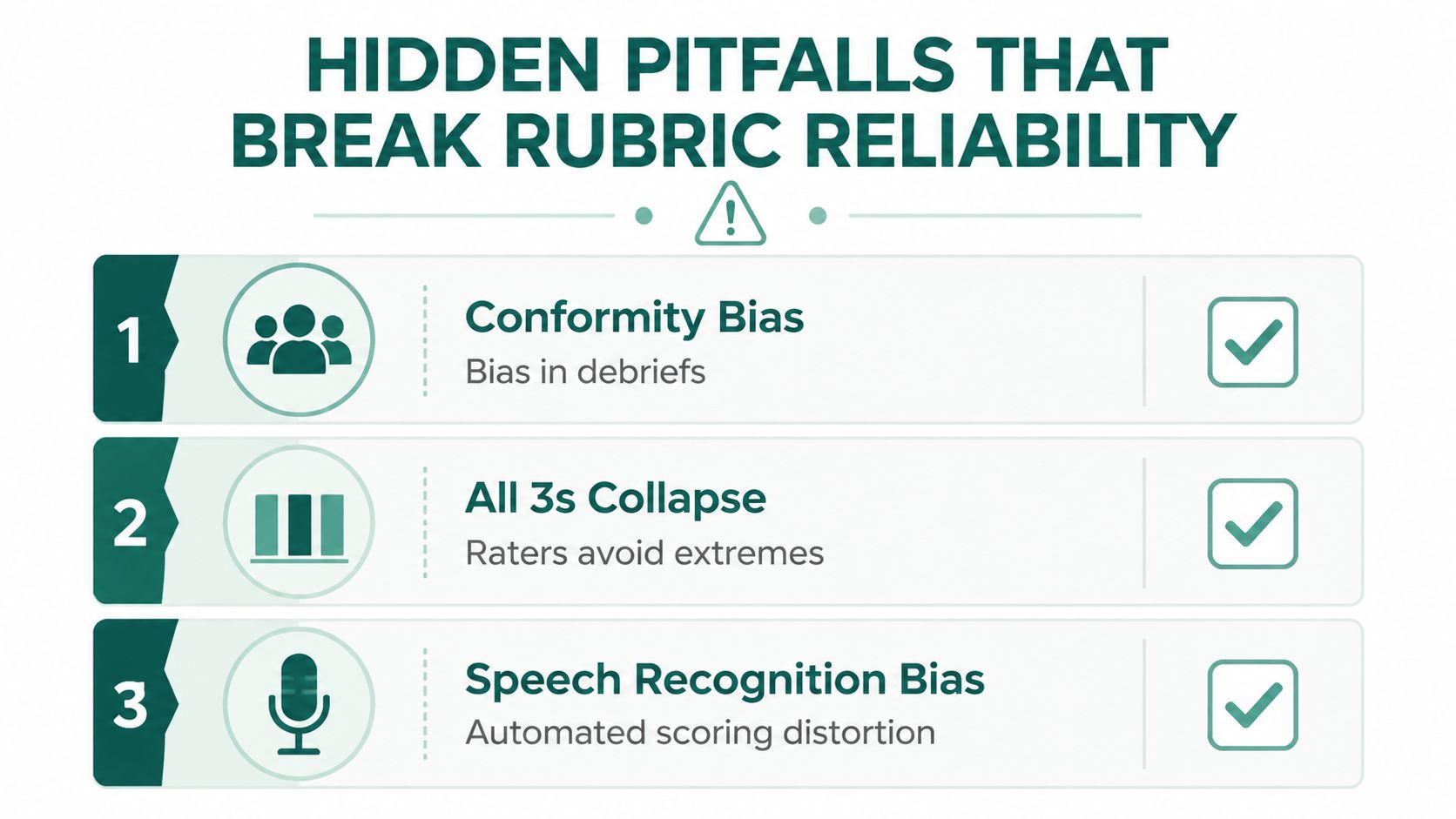
Consensus can hide disagreement. If one interviewer shares a confident opinion first, others may adjust their ratings even when their original evidence suggested something different. Independent scoring before discussion protects that initial signal.
The debrief should ask, “What evidence supports this rating?” before asking, “What's the group's conclusion?” That order keeps the conversation focused on observable behavior.
When interviewers give nearly every candidate a middle rating, the scale has stopped distinguishing performance. The problem may be unclear anchors, discomfort with extreme ratings, weak questions, or a culture that treats the rubric as administrative paperwork.
Track the shape of score distributions, not only average scores. Also examine inter-rater reliability, which indicates how consistently different interviewers apply the same rubric. A rubric that produces tidy consensus but little meaningful separation may be less useful than a rubric that surfaces explainable disagreement.
Diagnostic question: Are interviewers scoring the candidate, or are they protecting themselves from defending a strong rating?
Automated speech recognition can introduce another source of distortion in personnel selection. Transcription quality may vary across languages and accents, and that can affect the evidence an interviewer or system sees. Even when transcription differences don't fully become measurement bias, they create a risk that teams shouldn't ignore.
The guidance on rubric reliability and interview scoring recommends looking beyond templates by tracking inter-rater reliability, score distribution shape, and whether rubric scores correlate with later hiring outcomes. Those checks help reveal rubric decay, where criteria become generic, ratings cluster, or the recorded evidence no longer reflects the intended competency.
AI-assisted screening works best when automation collects consistent evidence while the employer retains ownership of the standard and decision. Talent Pronto's virtual assistant, Anna, conducts conversational screening around the clock, asks role- and industry-aware behavioral and technical questions, and prepares structured candidate scorecards based on employer-provided criteria.
That workflow addresses a practical problem in high-volume hiring. A rubric can't preserve validity if the screening questions don't reflect the job, if every role uses the same shallow score, or if the system makes advancement decisions without employer review.
Talent Pronto supports customized scoring rubrics and structured evaluations, with question sets that can cover behavioral, technical, cultural, and compliance topics. Employers can connect screening workflows with ATS and HRIS platforms such as Greenhouse, iCIMS, Paylocity, ADP, and Workday, allowing candidate data and statuses to sync with existing processes.
The employer still decides who advances or gets rejected. The platform provides structured evidence and criteria-based scoring, but it doesn't make final hiring decisions.
The important design choice is role specificity. A healthcare position may require compliance and patient-facing judgment. A manufacturing role may require safety reasoning and operational consistency. A technology role may require technical depth and problem-solving. A single uniform scale can't express those differences unless its anchors connect to the job.
AI also requires a review path for transcription and evaluator variance. Employers should check whether candidates receive comparable opportunities to answer, whether the system captures responses accurately, and whether human reviewers can inspect the reasoning behind a score. Preserving validity across languages, accents, and job families matters more than processing applicants faster.
Review the rubric, the questions, and the recorded evidence together. Look for criteria that interviewers interpret differently, questions that don't give candidates comparable opportunities to demonstrate skill, and scores that cluster without separating performance.
Compare interviewer patterns and inspect disagreement cases. If one criterion produces repeated variance, hold a focused calibration session and revise the anchor. Also review whether rubric scores connect logically to later hiring outcomes, while remembering that hiring outcomes can reflect factors outside interview quality.
Yes, provided the process remains standardized. Give every interviewer the same question set, scoring instructions, evidence-note expectations, and access to the same candidate information.
Remote panels need extra discipline around timing and debrief order. Ask interviewers to submit scores independently before opening the group discussion. Store the score and evidence in one shared system so the team doesn't reconstruct the interview from chat messages, memory, and separate documents.
Start with a shared document or form containing the criteria, questions, anchors, rating, and evidence note. Assign one person to own version control and require interviewers to complete their scorecards before the debrief.
Keep the first version narrow. Choose the capabilities that matter most for the role, test the questions with the hiring team, and update the anchors when repeated disagreements reveal ambiguity. A lightweight process can still be consistent if everyone uses the same questions, the same scale, and the same documentation habit.
Treat automated scoring as decision support, not an automatic verdict. Review whether the system's evidence is accurate, whether the rubric is role-linked, and whether human interviewers can challenge or contextualize a result.
The strongest process combines consistent evidence collection with human accountability. An employer should know why a candidate received a rating and should be able to review the underlying response before making an advancement or rejection decision.
Keep the disagreement visible. Ask each interviewer to identify the evidence behind the rating, then determine whether the difference comes from the candidate's answer, the question, the anchor, or the interviewer's interpretation.
If the same disagreement repeats, the rubric needs attention. Don't solve a design problem by pressuring the panel into artificial consensus.
Talent Pronto provides conversational screening, role-specific questions, customized rubrics, and structured scorecards that can connect with systems such as Greenhouse, iCIMS, Paylocity, ADP, and Workday. Visit Talent Pronto to see how your team can collect more consistent early-stage evidence while keeping hiring decisions with the employer.

Talent Pronto is an AI-powered hiring platform built around Anna, our intelligent AI that conducts 24/7 conversational screening, evaluates candidates against specific job requirements and compliance needs, and schedules interviews. Run everything on the Talent Pronto ATS, our all-in-one applicant tracking system with a branded careers site and Anna built in, or keep your existing ATS and let Anna integrate with Greenhouse, Ashby, iCIMS, Jobvite, Lever, Oracle, and more. Either way, we help organizations reduce time-to-hire and build stronger teams.