Optimize hiring with our guide to pre employment assessments. Make informed decisions and build a strong team for 2026.
You can feel the pressure before the hiring manager even sends the requisition. The inbox is already full, the role is urgent, and the first wave of applicants has turned into a stack of similar resumes that all claim the same skills. At that point, pre employment assessments stop being a nice-to-have and become the only practical way to add structure before opinion and fatigue take over.
A recruiter I worked with once faced more than enough applicants for a single operations role to fill a week with manual resume reviews. Every candidate had the right buzzwords, a polished title history, and a story that looked convincing at first glance. By the time the team reached interviews, they'd already lost time, consistency, and a clear reason for why one person moved forward over another.
Pre employment assessments solve that problem by adding structured evidence before human judgment starts to drift. SHRM reported that 54% of surveyed employers were using job simulations and 51% were using culture-fit assessments, and culture-fit use was up 22% from the organization's 2014 study, which shows these tools have moved into mainstream hiring practice rather than staying in a niche testing lane. In a separate HireVue/HR.com study, 90% of respondents said their assessment systems help them hire quality employees, which tells you employers now treat assessments as a decision layer, not an afterthought. Those figures matter because they show assessments aren't only about technical screening anymore, they're being used to evaluate fit, potential, and role readiness across the funnel. SHRM's overview of predictive assessments
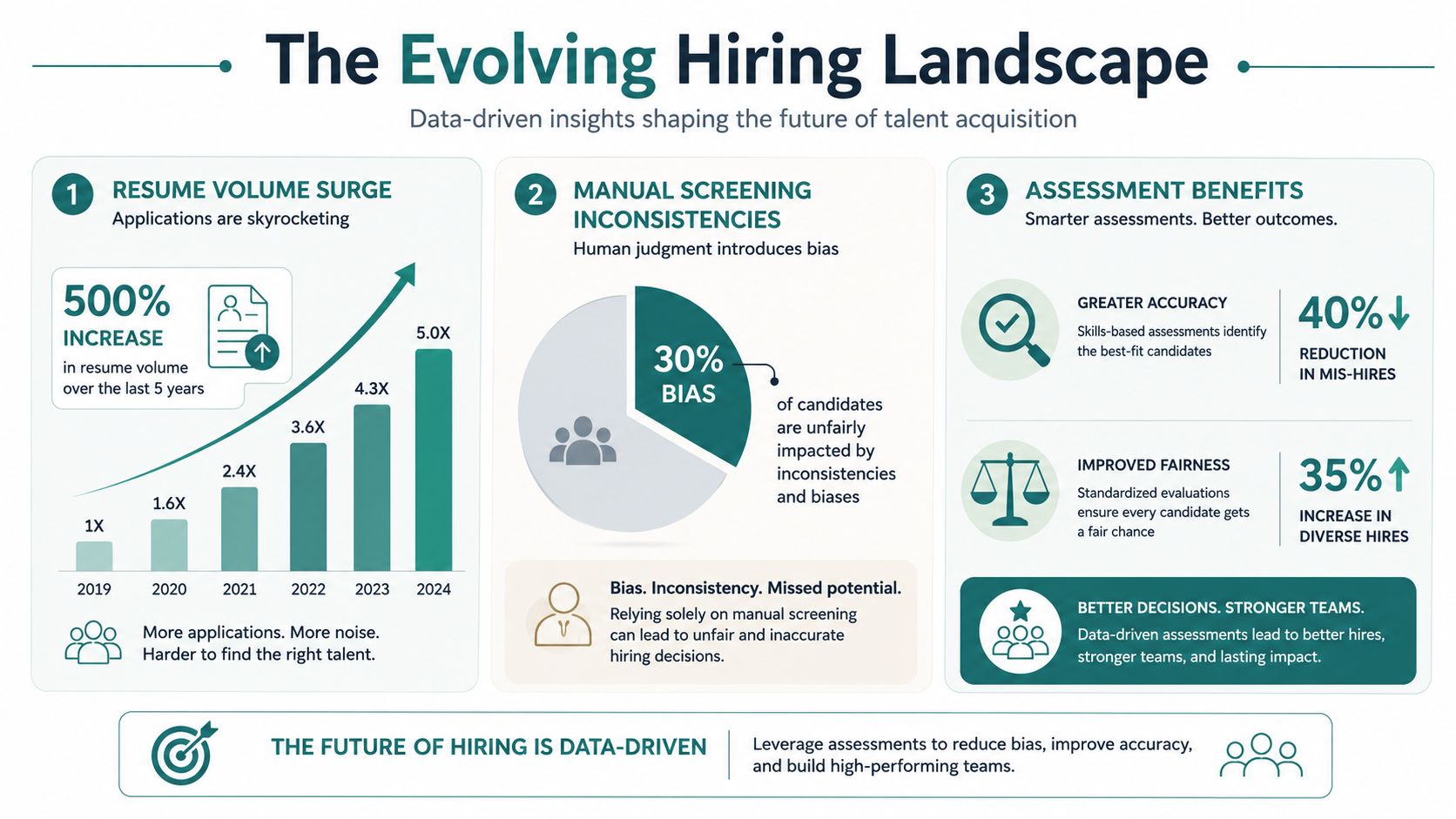
Manual screening creates the same failure modes over and over. Different recruiters weigh different signals, hiring managers overvalue the clearest storyteller, and the candidate with the strongest resume format can outrun the candidate with the strongest job fit. Once a funnel gets busy, that inconsistency becomes expensive.
Practical rule: if the role attracts volume, screen with a repeatable signal before you invest in human conversation.
Assessments bring the process back to something the team can defend. They create a common reference point for shortlisting, which is especially valuable when the role has high applicant volume, compliance sensitivity, or a narrow success profile. They also give candidates a clearer process, because a job-related exercise is easier to understand than a pile of opaque resume rejections.
The shift is operational. When screening is structured, the team spends less time arguing about subjective first impressions and more time discussing evidence. That's the point where assessments start improving hiring quality, speed, and fairness at the same time.
Not every role needs the same assessment mix, and that's where a lot of hiring teams go wrong. A single generic test usually over-measures one thing and under-measures the actual work. The better move is to match the instrument to the failure mode, then use more than one signal when the job demands it.
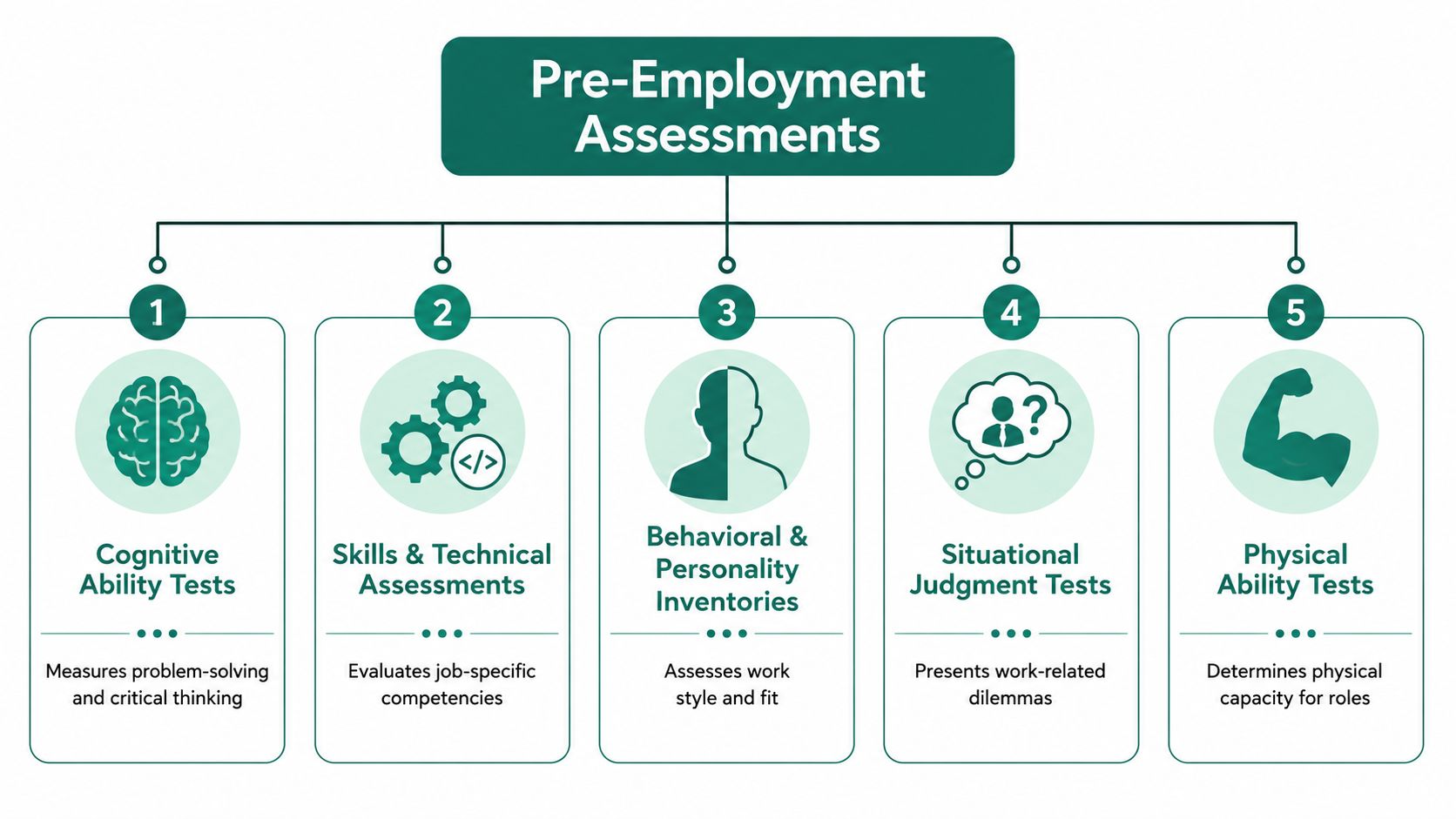
The category is broader than skills testing alone. Pre-employment testing can include cognitive ability, personality, aptitude, integrity, emotional intelligence, physical ability, and job simulations as defined in hiring glossary guidance. That range matters because different roles fail for different reasons.
Cognitive and aptitude tests are useful when a job requires problem-solving, learning speed, or complex judgment. Skills and technical assessments are the fastest way to verify that someone can perform the work, especially in coding, design, data, accounting, or customer operations. Behavioral and personality inventories help you understand work style, motivation, and how a candidate may function in a team. Situational judgment tests work well when the role depends on choices under pressure, like leadership or customer-facing work. Physical ability screens belong in jobs where the work itself has real physical demands.
A role with multiple critical demands usually needs a battery, not a single score.
That's the logic behind combining 2 to 4 assessment types when the job has several core competencies. Major vendor guidance notes that mixing cognitive ability, personality, and motivation improves predictive power because different constructs explain different parts of performance, and structured interviews are valuable because every candidate gets the same questions under the same conditions. In practice, that means you map competencies first, then choose the tools that match them rather than screening with whatever test is easiest to deploy. One example of behavioral assessment tooling in a hiring stack
A healthcare employer may combine compliance-related screening with behavioral questions so it can see both rule-following and patient-facing judgment. A tech team may lead with technical work samples and cognitive measures because those roles often hinge on problem-solving under ambiguity. A manufacturing team may need physical criteria that are explicitly tied to the job task, not a generic fitness check.
The point isn't to create a longer process. The point is to create a better one, where each assessment earns its place by telling you something the resume cannot.
A candidate can look strong on paper and still fail in the first few months because the role exposed something the resume never showed. That is where pre employment assessments help, but only if the tool is tied to the work and checked against real outcomes in your funnel. A polished test that is easy to deploy can still miss the behaviors that drive success in your environment.
The starting point is the role's most common failure mode. If new hires struggle with troubleshooting, assess troubleshooting. If they miss priorities, test prioritization. If they fall apart when requirements shift, use a structured scenario that forces judgment under ambiguity. Generic off-the-shelf tests often miss that connection, especially when the job has narrow technical demands or a very specific service style.
A practical validation process compares assessment results with six-month performance ratings and twelve-month retention across one to two years of hiring data. That shows whether the assessment predicts downstream success instead of just application completion. The work is not flashy, but it separates a screening tool from a selection system that holds up after onboarding. One useful reference point is Market and outcome data on pre-employment testing software, which discusses market growth and reported workflow gains from automated scoring and structured assessment libraries.
The harder lesson is that prediction can be real and still incomplete. A test may correlate with performance in one team and miss failure in another if the role mix, manager style, or delivery format changes. That is why employers should re-check their assessments against role failure modes, not just against a vendor's general validity claims. The goal is not to prove that every score matters equally, it is to confirm that the score predicts the outcomes your team cares about.
A newer layer is the ability to assess how candidates use generative AI and agentic AI tools in the early screening process. That does not mean replacing core job skills with prompt fluency. It means testing whether someone can use new tools responsibly inside the actual workflow, without losing judgment, accuracy, or compliance.
That shift also changes the economics of screening. AI conversational screeners can absorb routine first-pass questions, which gives recruiters more time for the cases that need human review. It also raises a new risk, because speed can hide weak validation if teams accept conversational output without checking whether it matches role success. Employers that want an equal-opportunity process should connect this layer to broader hiring policy, including the guidance in Talent Pronto's equal opportunity hiring resource.
Crosschq's critique is useful here, because it argues pre-hire assessments should not be treated as the sole predictor of quality of hire. That is a fair caution. The stronger approach is to use assessments as one input in a broader selection system, then verify them against the competencies and failure modes that matter for the role. In some hiring programs, that also includes partner-review workflows such as the Alignmint blog on background checks, especially when the role requires more than a simple skills screen.
A lot of teams create risk in this way. They buy a test, plug it into the funnel, and assume the vendor has handled everything. In reality, the employer owns the obligation to make the process fair, accessible, and properly validated.
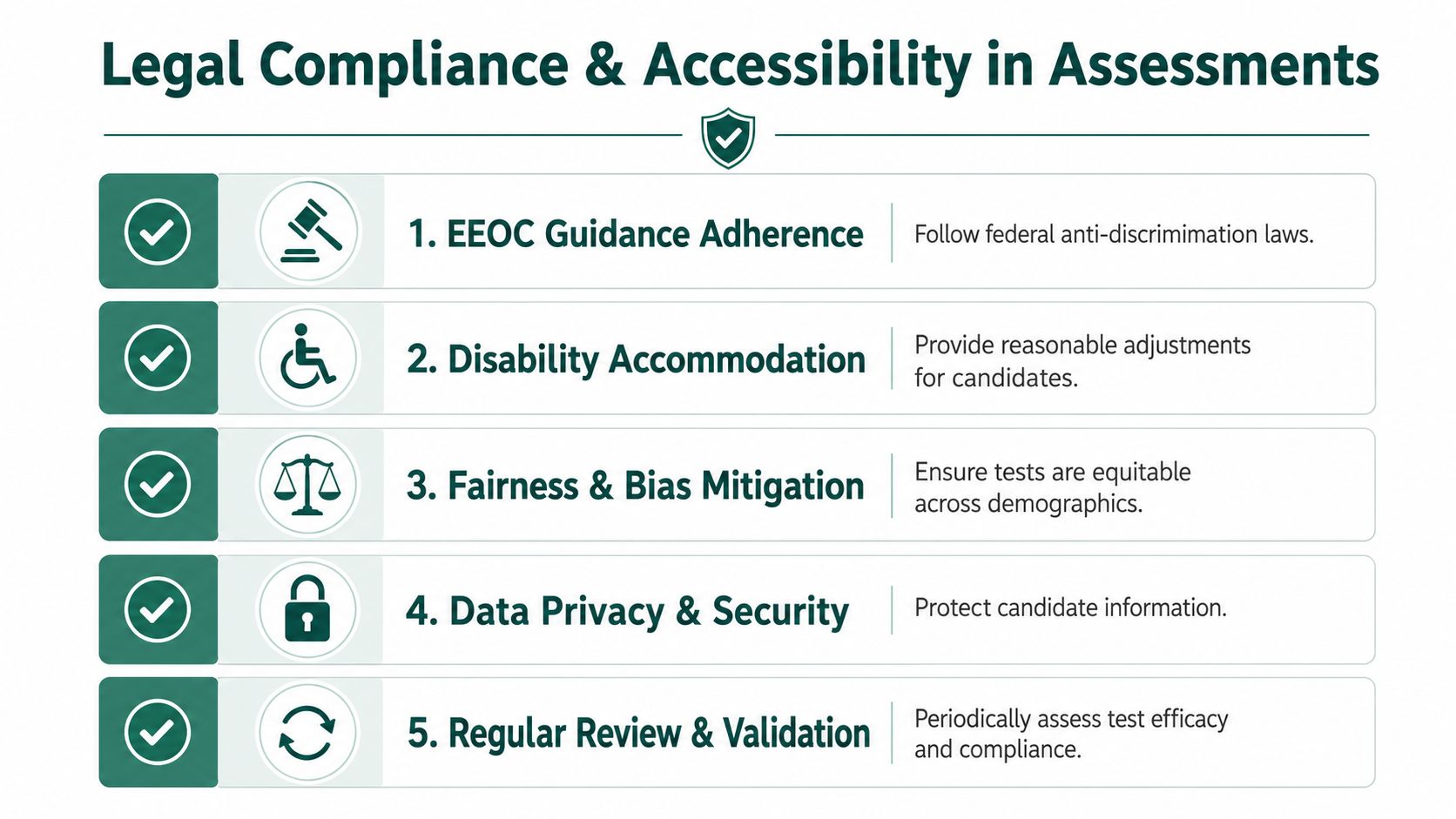
EEOC guidance says employers remain responsible for ensuring tests are administered without regard to disability and that the procedure is properly validated. JAN's best-practice guidance goes further and recommends a prominent accommodation-request procedure, an accommodations specialist, and vendor modifications when needed. That makes accessibility an operating process, not a nice vendor feature. EEOC guidance on employment tests and selection procedures
A psychometrically strong assessment can still be inequitable if the delivery format blocks some candidates. If the interface is incompatible with assistive technology, the time limit is rigid in a way that conflicts with accommodations, or instructions are inaccessible, the test has become a barrier rather than a screen. That's why accessibility planning has to happen before launch, not after an issue lands in your inbox.
For roles with physical or medical criteria, especially in healthcare, manufacturing, and public-sector environments, the standard has to be job-related and defensible. A Cochrane review found very low-quality evidence that general pre-employment exams do not reduce sick leave for light-duty workers, and evidence for job-focused exams reducing musculoskeletal injuries was inconsistent, while many job-focused exams substantially increased applicant rejection. That doesn't mean such screens are never appropriate. It means they need careful justification, direct job linkage, and legal review before they go live. Cochrane review on pre-employment medical exams
For a related policy lens, the Alignmint blog on background checks is a useful resource because it shows how screening practices can become legally and operationally messy when employers don't define the purpose and scope clearly.
If you want assessments to support equal opportunity, they have to be usable by the full applicant pool, not just the easiest candidates to process. That is exactly where many programs fail.
The fastest way to ruin an assessment program is to make every candidate take too much too early. People drop out when the process feels like unpaid work, and hiring teams lose signal when the stages aren't sequenced with intent. Good implementation is less about software selection and more about timing, scope, and integration.
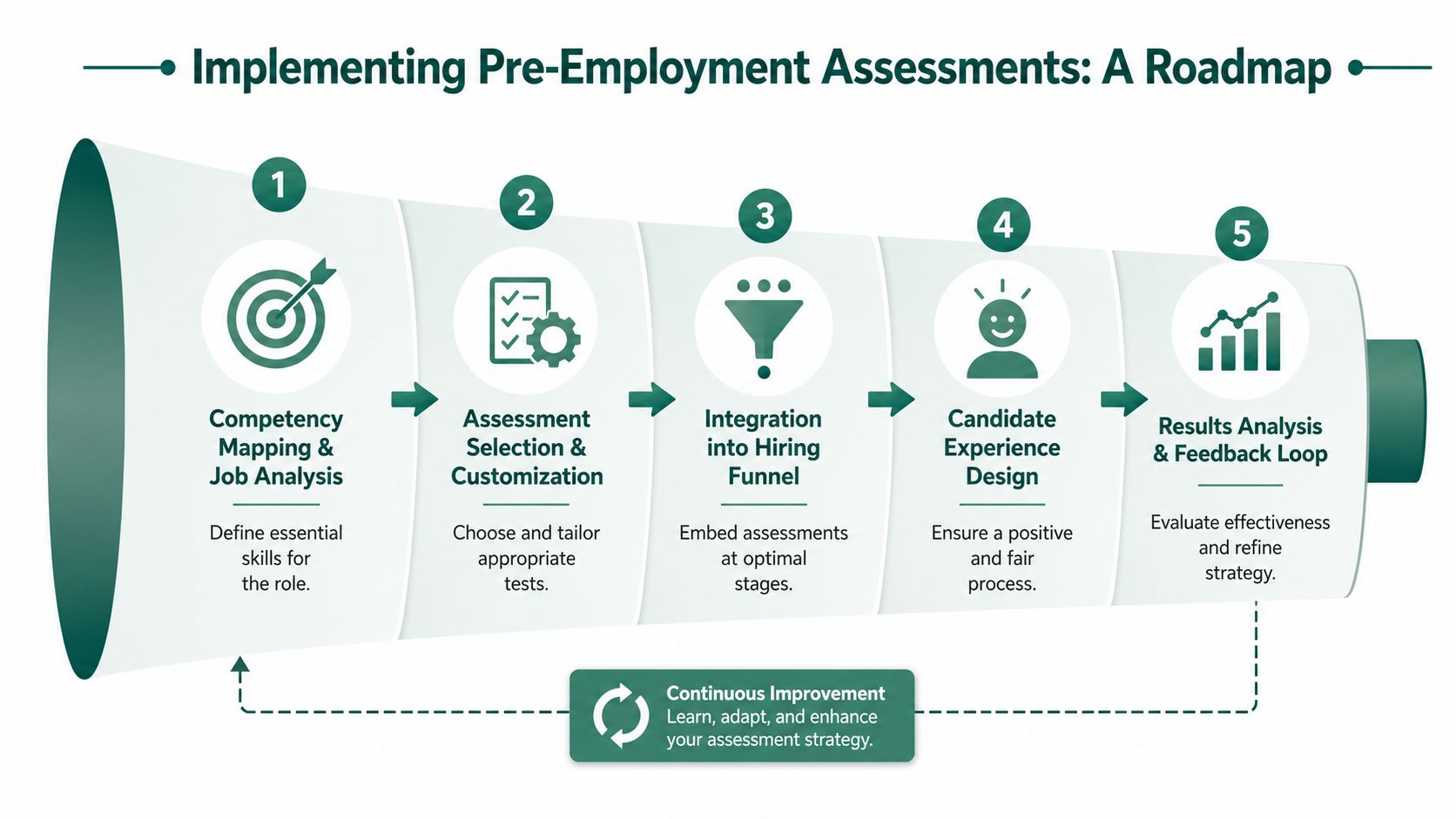
Start with competency mapping and job analysis. If you don't know what the role fails on, you'll choose the wrong tool. Then choose the assessment type, customize it to the job, and place it where it can eliminate weak fits before expensive human review.
Practitioner guidance recommends keeping pre-application screening under 10 minutes, post-recruiter-screen assessments under 45 minutes, pre-panel work samples or structured interviews under 90 minutes, and total candidate assessment time under 2.5 hours including interviews. Short early-stage instruments lower drop-off, while later-stage depth should be reserved for stronger contenders. Assessment timing guidance for funnel design
Short assessments belong early, deeper exercises belong later, and every extra minute needs a clear purpose.
Integration matters more than many hiring organizations anticipate. When assessment results sync into the ATS or HRIS, recruiters don't waste time duplicating data, and candidate status updates move cleanly from one stage to the next. That matters in high-volume funnels where even small manual delays create visible backlogs.
A sound rollout usually includes: - Role mapping: define the competencies and the failure mode for each job family. - Assessment selection: use the smallest battery that captures the most important signals. - Timing design: decide where the candidate should encounter each step. - Candidate communication: explain why the assessment exists and how long it takes. - Feedback loop: compare results to performance and retention after hire.
The best implementation teams treat the assessment as part of the hiring system, not a separate project. That's how they protect candidate experience while keeping the process tight enough to move.
Legacy ATS chatbots usually stop at collecting form fields. They ask for availability, shift preference, or a few knockout answers, then hand the rest back to the recruiter. That lowers admin load a little, but it doesn't change the quality of screening. Agentic AI conversational screeners do more because they evaluate, probe, and structure the interaction around the role itself.
A conversational screener can ask follow-up questions about experience, behavioral choices, and technical capability in a way that feels like a live exchange rather than a static form. Talent Pronto's virtual assistant, Anna, is built for this kind of workflow, with 24/7 screening across web and mobile, role-aware question sets, and structured scorecards that turn those answers into comparable evidence. Talent Pronto's recruitment chatbot overview
That changes the economics of early-stage hiring. Instead of waiting for business hours or forcing every applicant into the same manual queue, the system can engage candidates continuously, surface strong prospects sooner, and keep people moving when human teams are busy. It also reduces the common problem of good candidates going cold because nobody responded quickly enough.
The key distinction is that the AI isn't making the final hiring decision. It's organizing the early-stage evidence so humans can review better inputs sooner. That's very different from a simple chatbot, and it's why these tools have started to matter in high-volume and hard-to-fill funnels.
A pre employment assessment only earns its place if it keeps proving value after launch. Once it is live, I expect it to reduce friction, improve signal quality, and hold up against the outcomes that hiring leaders already care about. If it cannot show that connection, it becomes another layer of process that recruiters work around instead of with.
Track screening workload reduction, shortlisting throughput, time-to-fill, candidate completion rates, and retention at six and twelve months. Those measures show whether the assessment is reducing manual review, moving stronger candidates through faster, and producing hires who stay and perform after onboarding. Completion rates alone do not tell you whether you are finding better people or just processing them faster.
A practical dashboard should also show where candidates stall, which questions create drop-off, and whether certain stages are filtering out too many qualified applicants. That matters because a question that looks precise on paper can still create unnecessary friction in a real funnel, especially in high-volume hiring where small delays add up quickly.
Talent dashboards and advanced reporting help TA teams see those patterns early. They also make it easier to compare hiring managers, roles, and locations without relying on anecdotal feedback from the recruiters closest to the process.
The business case is already visible in the broader market. As noted earlier, the global pre-employment testing software market was valued at USD 1.9 billion in 2024 and is projected to reach USD 3.2 billion by 2030, which reflects continued demand for structured screening systems. Market projection and screening efficiency data
Validation should continue after the first rollout. Candidate pools shift, hiring managers refine what they need, and role requirements change as the work changes. AI-assisted workflows also change the economics of early screening, so a process that worked six months ago can drift if nobody checks it against current results.
For teams hiring in regulated or technically demanding environments, pairing hiring metrics with role-specific quality measures after onboarding gives a clearer read on whether the assessment is tied to real job performance. A useful outside example is leveraging AI for financial hiring, because it shows how selection quality, compliance, and workflow design can be tied together when the role has narrow failure modes and little room for error.
A strong assessment program earns trust in two ways. It speeds up hiring in the present, and it keeps showing that the people it advances are the ones who perform well later. That is the evidence stakeholders remember when they decide whether to keep, expand, or replace the process.

Talent Pronto is an AI-powered hiring platform built around Anna, our intelligent AI that conducts 24/7 conversational screening, evaluates candidates against specific job requirements and compliance needs, and schedules interviews. Run everything on the Talent Pronto ATS, our all-in-one applicant tracking system with a branded careers site and Anna built in, or keep your existing ATS and let Anna integrate with Greenhouse, Ashby, iCIMS, Jobvite, Lever, Oracle, and more. Either way, we help organizations reduce time-to-hire and build stronger teams.