Discover how a virtual interview platform accelerates hiring with AI screening, structured scoring, and ATS integration. Learn features, use cases, and ROI.
Most hiring teams are stuck in the same grind right now. A recruiter gets 400 applicants for one role, hiring managers want finalists by Friday, and the calendar is already full of interviews across time zones, shifts, or clinic hours. Manual screening turns that volume into delay, and delay turns strong candidates into drop-off.
A virtual interview platform is the cleanest way out of that mess when it's built correctly. Not a glorified video link, not an ATS chatbot, but a system that engages every applicant, standardizes early evaluation, and pushes qualified people forward without forcing recruiters to live in their inbox all day.
A recruiter with a heavy req load usually doesn't have a sourcing problem first. They have a screening bottleneck. The resumes are there, but every live phone screen takes coordination, every calendar thread creates friction, and every delay gives candidates another reason to disengage.
A hiring team that still depends on manual screening is managing volume with coordination work. That sounds controlled, but it breaks quickly. Strong candidates sit untouched while recruiters juggle schedules, and hiring managers end up reviewing a narrower pool than the role deserves.
That is why the market has moved so fast. In a 2026 HR industry roundup, 81% of recruiters use video interviews, one-way interviews are up 67% since 2020, and 90% of remote roles skip in-person interviews entirely. The same source says video interviewing can cut hiring timelines by about 8 days, with 45% of recruiters citing lower costs and 74% saying it makes shortlisting easier, which tells you where the pressure sits, early-stage coordination and funnel speed. HireTruffle's 2026 video interview statistics make the case plainly, this is now mainstream infrastructure, not an experiment.
When a team relies on manual screening, every applicant has to be touched by a human before the process moves. That sounds controlled, but it is brittle. A strong candidate can sit untouched for days while the recruiter plays calendar Tetris, and the hiring manager ends up reviewing a smaller, less representative pool than the job deserved.
A virtual interview platform fixes the structure, not just the interface. Candidates respond on their own time, recruiters review in batches, and every applicant gets a consistent entry point instead of an inconsistent response based on who had time to call first. That is the right way to think about it. A serious platform is not there to replace your hiring team. It is there to remove the repetitive coordination work that slows the team down and weakens the funnel before a real conversation even starts.
Practical rule: if your team cannot explain how it will handle a surge of applicants without adding headcount, the process is the problem, not recruiter productivity.
The market is also signaling that this is not a temporary remote-hiring workaround. Mordor Intelligence estimates the video interviewing platform market at USD 2.76 billion in 2025, rising to USD 3.13 billion in 2026 and reaching USD 6.29 billion by 2031, which implies a 14.98% CAGR from 2026 to 2031. Mordor Intelligence's market forecast points to a broader shift from simple video calls to recruiting infrastructure that can handle structured screening, assessment, and ATS integration.
A useful next question is whether the platform helps with scoring discipline, accessibility, and bias control, or just moves interviews into another interface. Teams that use Talent Pronto's AI-powered talent intelligence platform are already asking that harder question, because speed alone does not fix a weak screening model.
A true virtual interview platform starts inside the hiring workflow, not outside it. The invitation can trigger from an ATS stage, the candidate can complete the interview asynchronously or live, and the outputs can flow back into the candidate record instead of living in a separate inbox or spreadsheet. That integration path is what separates a platform from a standalone video tool. Tavus describes ATS-triggered invitations, rubric-based scoring, and ATS sync, which is the right operating model for modern screening.
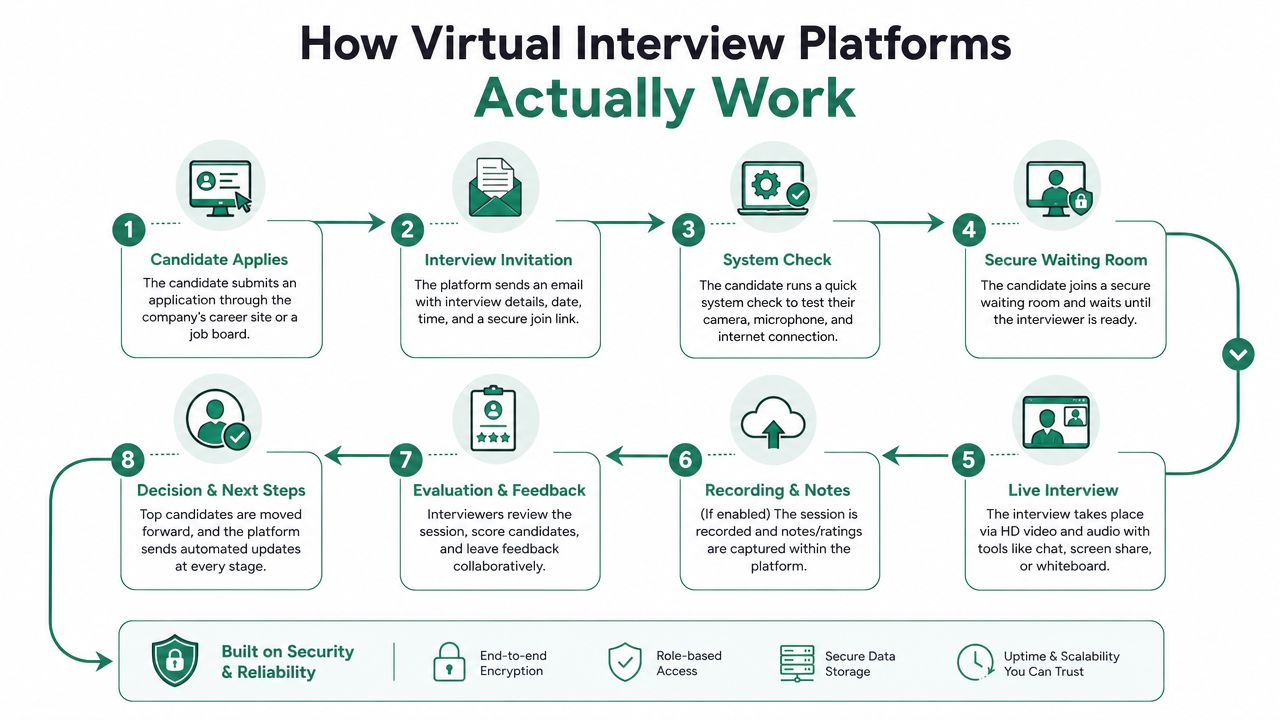
In practice, the flow is simple. A candidate applies, the platform sends a structured interview, the candidate responds on their own schedule, and the system returns evaluated outputs to recruiters. That can include question-level evaluations, summaries, transcripts, and scorecards that are ready for review in the ATS. BrightHire's platform description shows why this matters for high-volume screening, because the recruiter no longer has to manage live scheduling before any meaningful assessment happens.
The architecture underneath matters more than most buyer demos admit. One platform example uses WebSockets to broadcast candidate status changes in real time across admin, employer, and candidate views, while creating and tearing down video rooms on demand to keep queue state clean and reduce idle overhead. This engineering example is the difference between a system that merely records calls and one that coordinates an interview workflow.
A video call captures conversation. A virtual interview platform captures process, state, and decision-ready output.
The parts that matter are not flashy. You want event-driven state management, role-based access control, and mobile-responsive entry points so candidates can join without friction. You also want the platform to keep the candidate waiting room, interviewer queue, and reporting view consistent, because state drift creates bad operations fast.
For a deeper view of how these systems fit into broader talent operations, see this Talent Pronto overview of AI-powered talent intelligence. The right mental model is simple. A basic tool records. A real platform evaluates, routes, and syncs outcomes into the hiring system you already use.
Most buyers compare tools by feature count and end up missing the actual distinction. Legacy ATS chatbots collect fields. Basic video tools host calls. A real virtual interview platform probes candidates, structures review, and returns evidence that recruiters can use without rebuilding the process by hand.
| Capability | Virtual Interview Platform | Legacy ATS Chatbot |
|---|---|---|
| Candidate engagement | 24/7 conversational screening across web and mobile | Form collection during application flow |
| Question design | Role-aware and industry-aware question sets | Generic prompts or fixed forms |
| Evaluation | Customized scoring rubrics and structured scorecards | Limited intake fields, little or no scoring depth |
| ATS workflow | Triggers from ATS stages and syncs back to records | Often one-way or manual export |
| Recruiter value | Shortlists, summaries, and decision-ready outputs | More data entry, not less |
| Candidate experience | Mobile-friendly, flexible, and self-paced | Usually linear and rigid |
One of the strongest advantages is asynchronous, structured evaluation. Candidates can respond on their own schedule, and recruiters get question-level evaluations, summaries, transcripts, and scorecards without juggling calendar threads. HireVire's explanation of asynchronous virtual interviews matches what most high-volume teams need, 24/7 candidate engagement without forcing live coordination.
You also need scoring that holds up under scrutiny. Structured interviewing guidance recommends 3 to 5 key competencies per role, scored on a simple scale such as 1–5 or labels like Below / Meets / Exceeds Expectations, with written justification tied to specific examples. LatHire's rubric guidance is the right model because it forces consistency instead of vibes.
A chatbot can ask questions. A platform can do much more. It can ask, score, summarize, and sync the result back into the hiring record, which is why ATS integration matters so much. iMocha's coverage of virtual interview platforms also points to the broader shift toward unified dashboards and embedded workflows, but buyers should keep asking the harder question, who controls the final hiring decision.
For a direct comparison of platform capabilities and legacy chatbot behavior, see this internal overview of video interviewing platforms. The test is simple. If the tool doesn't reduce coordination and improve evaluation quality, it's not solving the core problem.
Most demos are built to impress recruiters, not to survive real implementation. That's why vendor selection should start with operational questions, not feature marketing. If the platform can't fit your ATS, scoring model, accessibility needs, and rollout timeline, the rest is noise.
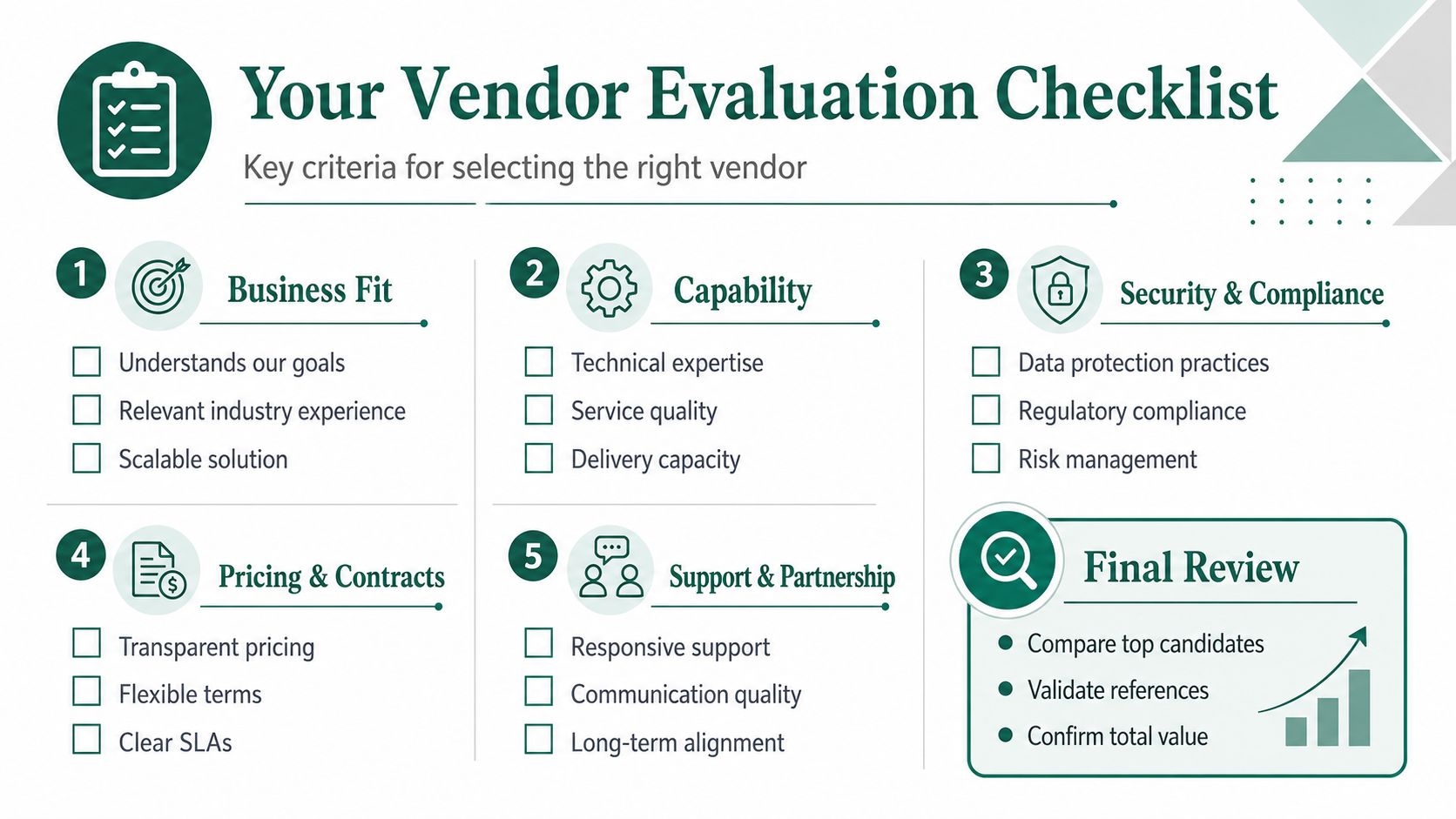
Ask which systems it connects to and how much data moves both ways. A platform should sync candidate data and statuses with your ATS or HRIS, not create another place for recruiters to copy and paste. In the Talent Pronto product materials, the listed integrations include Greenhouse, iCIMS, Workday, ADP, and Paylocity, which is the kind of integration breadth that matters when you're trying to avoid duplicate admin work.
A vendor should show you the exact rubric logic, not a generic “AI score.” Ask how many competencies can be scored per role, how written justifications are stored, and whether the output supports audit review. Accessibility is just as important. Independent guidance on accessible virtual interviews emphasizes WCAG-aligned platforms, accessible document formats, alternative text, real-time captioning, extra interview time, and flexible communication methods for candidates who need accommodations. Jobma's accessible virtual interview guidance makes clear that accessibility audits and recruiter training are part of the job, not optional extras.
If the vendor can't explain its accommodation flow in plain language, you're not buying an inclusive screening system.
If you want a vendor that addresses these operational details, Talent Pronto is one option worth evaluating because it combines conversational screening, structured scoring, and ATS/HRIS integration in one workflow. Buyers should still compare it against their current process, but that combination is what serious teams should be asking for.
A good platform does not look identical across every hiring model. The strongest use case in healthcare is different from the strongest use case in retail, and trying to force one process onto every function usually creates friction somewhere else.

Healthcare teams need structured screening that can evaluate clinical knowledge, compliance awareness, and role fit without dragging every candidate through repeated live calls. Manufacturing and logistics teams care about always-on screening because shift-based hiring doesn't stop when the recruiter logs off. Retail and hospitality teams need mobile-first flows and fast scheduling during seasonal spikes. Tech teams usually care more about consistent behavioral and technical evaluation across distributed interview panels.
That's where platform design matters. Role-aware question sets, instant resume evaluation, and proactive outreach help surface the right people sooner, but the configuration should match the job family. A generic screening flow will frustrate a nurse candidate and underqualify a software role in exactly the same way.
The outcomes are practical, not magical. High-volume teams reduce coordinator workload because fewer live screens need to be scheduled before the first evaluation. Hard-to-fill professional roles move faster because qualified candidates are engaged sooner. Compliance-sensitive teams get documented scorecards that are easier to defend later. Those are different outcomes, but they all come from the same core mechanic, structured screening at scale.
The current market trend toward specialized recruiting infrastructure backs that up. Mordor Intelligence's market forecast points to demand for systems that support live interviews, on-demand responses, candidate assessment, and ATS integration, not just generic video meetings. That market shift fits what most hiring leaders already feel, hiring teams need process control more than more tools.
The best platform for your team is the one that matches your hiring pattern, not the one with the longest feature list.
If your pipeline is mostly hourly volume, prioritize mobile access, self-serve completion, and fast routing. If your roles are specialized, prioritize structured rubrics, question customization, and review quality. If your process is regulated, prioritize documentation and accessibility first.
Hiring leaders worry that AI screening can introduce bias, and that concern is justified. The mistake is assuming the answer is to avoid structured screening. The bigger risk is unstructured human judgment, because it is harder to compare, harder to audit, and easier to defend with gut feel than with evidence.
Well-designed platforms use standardized questions and tiered rubrics so every candidate is judged against the same criteria. That makes results easier to compare and easier to review later. The platform supports evaluation, but the employer still makes the hiring decision. The system does not decide who gets hired.
The strongest governance approach is plain and disciplined. It relies on written justifications, consistent scoring language, and scorecards that can be reviewed later. That is why rubric design matters so much earlier in the process, because fairness starts before the first response is recorded.
If a candidate cannot fully participate, the process is not fair. Accommodation planning has to be built into the platform choice, not added after launch. Accessible virtual interview guidance calls for real-time captioning, flexible communication methods, extra time where needed, and platforms aligned to accessibility standards. Talent Pronto's governance materials and broader accessibility guidance point to the same operational reality, fairness needs a documented process, not a hopeful one.
Platforms also need to work for the people using them. A candidate on a mobile device, a candidate using assistive technology, and a recruiter reviewing responses later all need a process that holds up without manual workarounds.
The real test is simple, can a hiring manager explain why one candidate advanced and another didn't without falling back on a vague “better fit” label.
Candidate trust drops when the process feels opaque. It improves when candidates know what they are being evaluated on, when employers document the criteria, and when the final decision stays with people who can be held accountable for it. A useful AI governance policy from Talent Pronto gives hiring teams a cleaner way to define that accountability before the first interview goes live.
Recent platform analysis also shows how much attention the market gives to AI-powered screening and ATS integration, while leaving the harder questions about transparency and governance on the table. iMocha's platform analysis makes that gap clear.
Buyers should stop asking whether AI screening is risky in the abstract. Ask whether the platform supports fair criteria, visible scoring, auditability, and accommodations. If it does, it belongs in the process.
The best implementation projects are the ones that stay narrow at first. Teams that try to redesign everything at once usually end up slowing the rollout and confusing hiring managers. Keep the first deployment tied to one or two role families, one scoring model, and one ATS workflow.
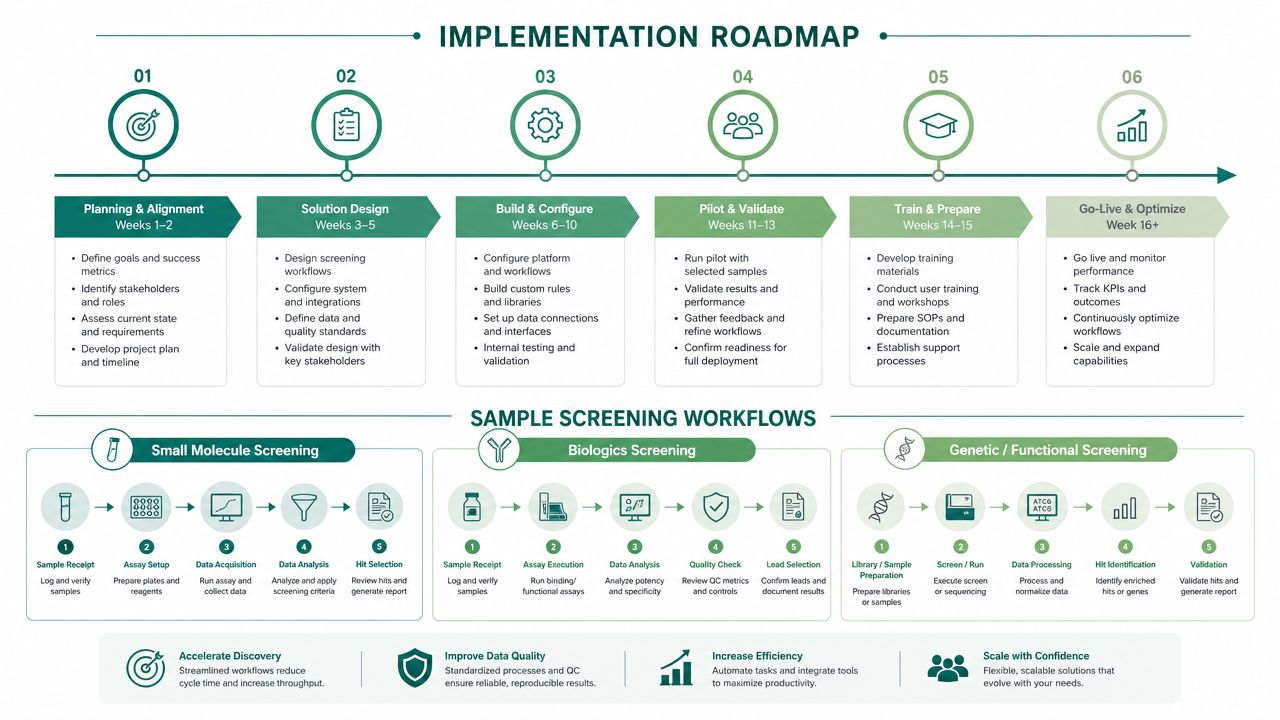
Start by defining the role-specific competencies you care about. Then build the question set, set the rubric, and map the ATS triggers that will launch the interview. If your platform supports mobile entry, test it on the devices your candidates really use, not just on a desktop in the recruiting office.
Typical implementation for well-designed platforms takes 1 to 3 weeks, which is fast enough that the biggest delays are usually internal, not technical. That means rubric design, manager alignment, and compliance review should be scheduled up front. Once the process goes live, the ATS should receive the scorecard and status updates automatically so recruiters don't have to re-enter data.
For high-volume hourly roles, send the interview immediately after application, let candidates respond on their own time, and route qualified people to scheduling only after they clear the first screen. For hard-to-fill professional roles, use structured follow-up questions and proactive outreach to keep strong candidates engaged instead of waiting on calendar availability. For compliance-sensitive roles, keep the rubric narrow, document the justifications, and make sure every score can be reviewed later.
The workflow differences matter because the implementation goals are different. In hourly hiring, speed is the point. In professional hiring, consistency matters more. In regulated hiring, documentation comes first.
Track reduced time-to-fill, improved candidate quality, lower coordinator workload, and higher completion of next steps. Do not confuse activity with progress. A team can send more invites and still fail if the scoring model is vague or if hiring managers ignore the structured outputs.
The most common mistake is underestimating rubric design time. The second is training hiring managers on the scorecard too late. If they don't trust the structure, they'll default back to informal judgment and the whole rollout loses value.
If you want a platform that handles conversational screening, structured scorecards, ATS/HRIS syncing, and candidate Q&A in one workflow, take a look at Talent Pronto. It's built for teams that need to screen every applicant without adding manual coordination, and it's worth evaluating if your current process is still stuck in live-call bottlenecks.

Talent Pronto is an AI-powered hiring platform built around Anna, our intelligent AI that conducts 24/7 conversational screening, evaluates candidates against specific job requirements and compliance needs, and schedules interviews. Run everything on the Talent Pronto ATS, our all-in-one applicant tracking system with a branded careers site and Anna built in, or keep your existing ATS and let Anna integrate with Greenhouse, Ashby, iCIMS, Jobvite, Lever, Oracle, and more. Either way, we help organizations reduce time-to-hire and build stronger teams.