Learn what automated candidate screening is, how conversational AI and scoring work, benefits, use cases, and how to implement it responsibly.
A recruiter opens the hiring dashboard on Monday morning and finds hundreds of new applications waiting. By the time each resume is read, compared, and discussed with a hiring manager, promising candidates may already have moved on. Applicants are also waiting for answers, often with no clear idea whether anyone has reviewed their information.
Automated candidate screening addresses that bottleneck, but the useful version is more than a resume filter. It combines resume evaluation, conversational questions, structured scoring, candidate communication, and human review. The system handles repeatable early-stage work while recruiters retain responsibility for decisions that require context, judgment, and accountability.
This guide builds the idea from the ground up. You'll see how screening has moved from keyword matching toward conversational evaluation, how role-specific scorecards shape results, how ATS and HRIS integrations connect the workflow, and why governance matters as much as speed. You'll also learn how to measure completion, fairness, and funnel quality instead of treating faster processing as the only sign of success.
Manual screening creates a difficult trade-off. A recruiter can read every application carefully, but that approach becomes harder as volume grows. Or the recruiter can move quickly, but rushed reviews may miss transferable skills, overlook useful context, or apply different standards at different points in the day.
Applicant tracking systems helped employers organize that work. As ATS adoption spread across large employers, early resume triage increasingly moved into software. A 2026 industry compilation reported that 97.8% of Fortune 500 companies had a detectable ATS in 2025, while another estimate cited by the same compilation placed adoption at 70% of large companies and 35% of small and medium-sized businesses. The ATS statistics compilation also reported that top users automate 75% of resume screening, reducing average screening time from 10 minutes per application to 45 seconds.
Those figures describe a major workflow change. Screening isn't only a recruiter opening one resume after another. It now often begins with parsing, keyword matching, ranking, and automated communication. That creates capacity, but it also raises a more important question: what exactly is the system evaluating?
A keyword filter can identify a term in a document. A conversational system can ask a candidate to explain how they handled a relevant situation, clarify experience that isn't obvious from a resume, and record the response against a defined rubric. That distinction matters for candidates with nontraditional titles, transferable skills, career changes, or experience expressed in language different from the job description.
Adoption is real but uneven. One 2026 recruiting statistics roundup reported that 69% of companies use AI in some capacity, while only 18% use it broadly across hiring processes. The same reporting stream identified resume screening, candidate search, and applicant communication as common uses. The iCIMS AI adoption report also cited chatbot-based screening in 73% of organizations in one dataset.
The practical lesson is simple. Automation works best as an assistant that applies agreed criteria consistently, keeps candidates engaged, and prepares evidence for human review. It shouldn't become the final decision-maker.
By the end of this guide, you'll be able to map your own screening funnel, define a useful scorecard, choose where conversation belongs, connect the workflow to your existing systems, and set safeguards that make the process more explainable and defensible.
Start with two different tools sitting beside the same hiring team.
The first is a filing clerk. It receives resumes, looks for matching words, sorts documents, and applies preset rules. It may be efficient, but it doesn't ask a follow-up question or understand why a candidate's experience matters.
The second is a trained interview assistant. It reads the role requirements, asks relevant questions, listens to responses, identifies evidence, and organizes that evidence for a recruiter. It doesn't decide whom to hire. It prepares a consistent evaluation so a human can make a better-informed decision.
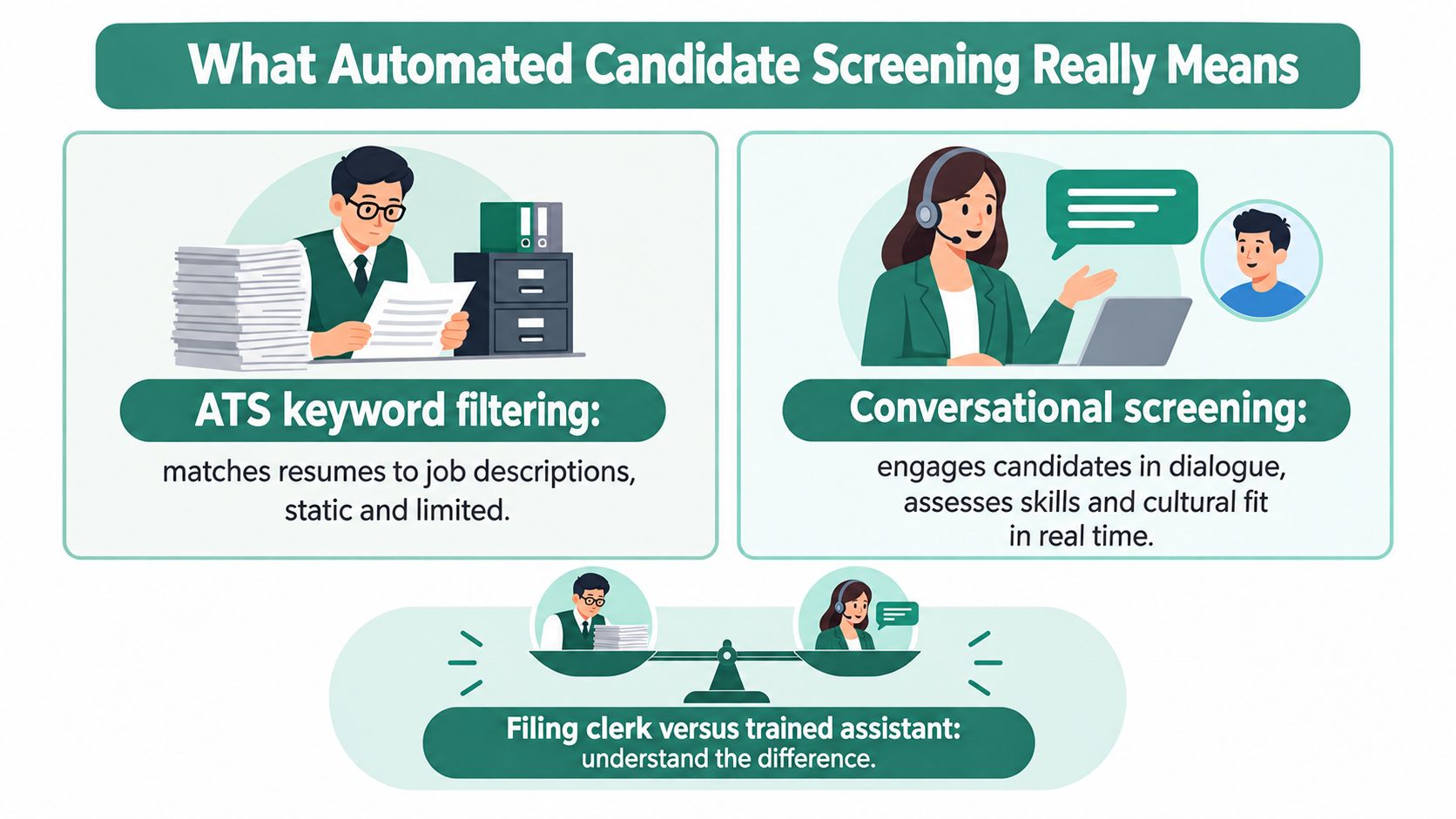
Traditional ATS filtering generally checks application data against terms and rules. That remains useful for basic requirements, such as whether an applicant has a required certification or can work in a stated location. But a rigid filter can struggle when a candidate describes the same capability using different language.
Conversational screening adds another layer. A role-aware assistant can ask about technical experience, behavioral examples, availability, communication, or compliance-related requirements. An agentic AI system doesn't merely collect form fields. It follows an evaluation plan, probes for relevant evidence, and organizes responses according to the role.
A useful plain-language explanation for a hiring manager is:
An ATS filter sorts applications by matching information. Conversational screening asks structured questions and produces evidence-based scorecards for human review.
The distinction also clarifies what automation shouldn't do. It can rank, summarize, flag, and route candidates. The employer still defines the criteria, reviews the evidence, handles exceptions, and makes advancement or rejection decisions.
A conversation without a scoring framework can create the same inconsistency as an unstructured phone screen. Before configuring questions, the hiring team should identify the capabilities that matter, separate essential requirements from preferences, and decide what evidence would support each score.
For example, a customer support role might assess:
That framework turns a conversation into a comparable evaluation. For a broader foundation, see this explanation of what candidate screening involves.
The workflow begins before a recruiter opens a candidate profile. A candidate applies through a web or mobile experience, and the screening system can invite the person into an asynchronous conversation. That availability matters for applicants who can't coordinate a traditional phone call during business hours.
A typical flow looks like this:
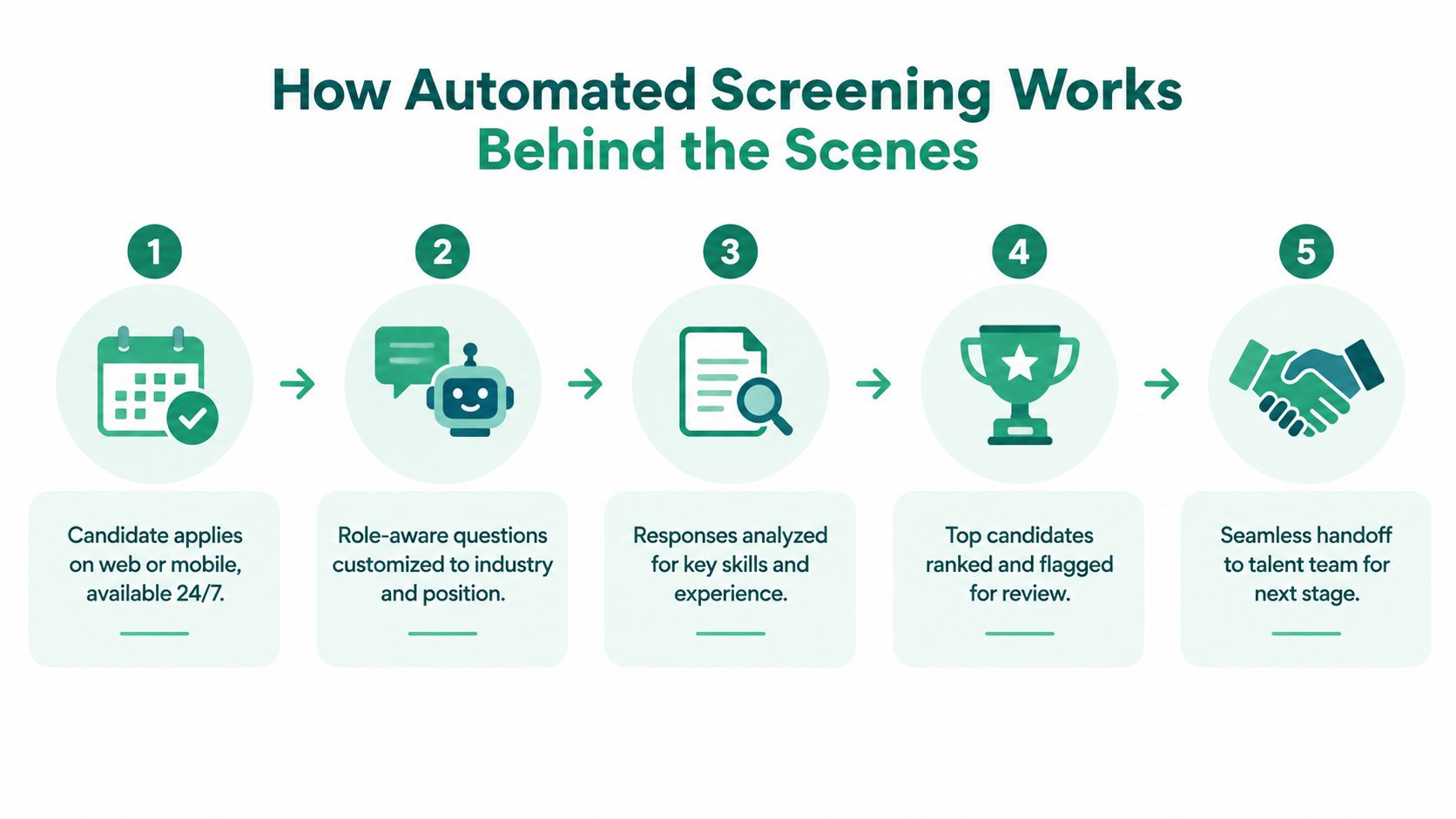
A candidate may begin by submitting a resume, then receive questions about relevant skills, prior situations, availability, or role expectations. The system can also answer questions about compensation, benefits, culture, and process details when the employer has supplied that information.
That exchange should feel like a focused first conversation, not a maze of forms. The assistant needs to explain what happens next, use plain language, support mobile participation, and allow candidates to opt out when a traditional submission path is available.
The explanation of how AI assistants work helps distinguish a conversational assistant from a chatbot that only collects fields. The assistant's value comes from connecting questions to an evaluation plan, not from adding chat for its own sake.
The hiring team defines the scorecard before candidates enter the process. Each criterion should have a clear meaning, a reason for inclusion, and a way to distinguish strong evidence from weak or missing evidence.
A scorecard might include:
The output should include reasons, not just a rank. Recruiters need to see which response supported a score, which requirement remains unclear, and where human follow-up is necessary. A high ranking without an explanation creates a new black box instead of improving the old one.
An ATS or HRIS remains the system of record. Screening software should pass candidate data, statuses, notes, and next steps back into systems such as Greenhouse, iCIMS, Paylocity, ADP, and Workday. That connection reduces duplicate entry and prevents recruiters from maintaining a second, disconnected candidate list.
Implementation commonly takes 1 to 3 weeks, according to the publisher's product information, but the timeline depends on role configuration, approval processes, integrations, and testing. The technical connection is only one part of the work. Teams also need to test question wording, review scorecard outputs, confirm candidate notices, and agree on who handles exceptions.
A short walkthrough can make the flow easier to visualize:
The strongest argument for automated screening isn't that software makes hiring feel futuristic. It's that a well-designed workflow removes delays that harm both recruiters and applicants.
A recruiter who receives an application outside working hours can't conduct a live phone screen immediately. An always-on conversational flow can acknowledge the candidate, collect relevant information, answer approved questions, and offer scheduling options without waiting for the next business day.
Automation handles repetitive review, but the quality of that assistance depends on the evaluation design. A structured rubric gives each applicant the same core opportunity to address the role's requirements. Recruiters then spend more time comparing evidence, resolving ambiguity, and speaking with candidates who need human conversation.
The workflow can also reduce reliance on polished resumes. A candidate who uses different terminology may still demonstrate the required capability during a focused conversation. That doesn't eliminate judgment, but it gives the hiring team more evidence than a narrow keyword match.
Candidate experience is equally important. A 2025 to 2026 research summary reported that 60% of candidates said AI improved their experience, while 20% said it worsened it. Another 2026 article reported that 38% of candidates walk away during AI-led hiring flows. These figures show why speed alone isn't enough. The candidate experience research summary points toward a practical measurement problem: employers need to understand when automation supports completion and when it creates abandonment.
Mobile-friendly, asynchronous screening can meet candidates when they have time to respond. One 2026 mobile recruitment source reported async screening completion rates from 75% to 90%, compared with phone-screen scheduling completion rates typically under 50%. The mobile recruitment data connects completion with the design of the early funnel, not merely the presence of AI.
That means teams should monitor:
Fairness principle: Automation can support consistent evaluation and auditability, but only when employers keep human oversight, inspect outcomes, and correct the process when evidence shows a problem.
The benefit is therefore conditional. Faster screening helps when the questions are relevant, the experience is transparent, and the scorecard measures job-related evidence. Poorly designed automation can move confusion earlier in the funnel.
The right screening workflow depends on the job, the applicant volume, and the kind of evidence the employer needs. A retail employer may need availability and customer scenarios. A healthcare organization may need role qualifications, communication, and compliance-sensitive questions. A software team may need technical reasoning that a resume can't establish alone.

A health system hiring for recurring clinical or administrative roles can use structured questions to confirm relevant experience, communication habits, schedule requirements, and required credentials. The system can identify responses that need recruiter verification, but a qualified human must remain responsible for validating credentials and making the employment decision.
Health tech, pharma, and biotech employers may use conversational screening to explore specialized experience while allowing technical leaders to review a consistent summary rather than scattered notes.
A distribution center may need to process applicants for shift-based roles quickly. A hospitality team may need to ask about guest interactions, schedule flexibility, and handling difficult situations. A retail manager may care about availability, communication, and comfort with customer-facing work.
These roles benefit from mobile access and immediate next steps, but the questions still need local context. A generic script can create friction if it ignores shift realities, transportation concerns, language needs, or the difference between seasonal and permanent work.
A professional services firm might evaluate client communication, analytical reasoning, and examples of project ownership. A government employer may need a documented, consistent process that supports public-sector requirements and review. A technology team may combine resume evidence with questions about architecture, debugging, or collaboration.
Teams comparing providers by sector can consult which industries we support as a useful way to think about industry-specific screening needs, even when the final tool choice differs.
The common pattern is not “use the same bot everywhere.” It is configure the conversation around the work, then preserve human review where context, credentials, safety, or public accountability matter most.
Implementation starts with the role, not the vendor demo. Write the evaluation criteria first, identify which questions produce useful evidence, and decide what the system may recommend versus what only a recruiter may decide.
Employer customization matters because a healthcare coordinator, warehouse associate, software engineer, and public-sector analyst shouldn't receive the same conversation. Strong onboarding should help the team configure roles, test question paths, connect systems, and review scorecard outputs before launch. Depending on the plan tier, a provider may also offer guided onboarding, dedicated account management, and dashboard analytics for monitoring funnel health.
Use these questions during evaluation:
A practical Responsible AI Governance Playbook can help teams turn broad principles into ownership, documentation, monitoring, and escalation procedures.
New York City's Local Law 144 requires annual, independent bias audits for automated employment decision tools used in hiring or promotion. Employers must also notify candidates and employees at least 10 business days before using such a tool and offer an alternative selection process if requested. The 2026 compliance guidance explains these requirements.
California's October 2025 regulations prohibit automated decision systems or selection criteria that discriminate based on protected characteristics. They also require meaningful human oversight and four years of record-keeping. The California employment law analysis provides the relevant context.
The EU AI Act classifies systems used for recruitment, CV screening, interview scoring, and candidate ranking as high-risk. Obligations include conformity assessment, logging, transparency, risk management, human oversight, and registration in an EU database before deployment. This EU AI Act hiring overview outlines those duties.
Bias testing must also be treated as ongoing work. One Brookings review examined 27 tests across three large language models and nine occupations and found gender parity in only 37% of cases, while documenting significant discrimination across gender, racial identities, and intersections. The Brookings review demonstrates why consistent scoring isn't the same as fair scoring. Employers should pair structured evaluation with independent testing, documented human review, candidate notice, and a process for correcting harmful outcomes. For practical design ideas, see bias mitigation strategies for hiring.
Automated candidate screening is most useful when employers stop treating it as a faster resume pile. The meaningful shift is from static filtering to a conversational evaluation system that asks relevant questions, captures evidence, applies a role-specific rubric, and routes the result to a human.
Begin with one role where the current funnel has a clear problem. Document the requirements, write the scorecard, test the questions with internal reviewers, and measure completion from invitation through handoff. Include candidate feedback, mobile performance, response timing, advancement patterns, and reviewer agreement, not just the number of applications processed.
Then connect the workflow to the ATS or HRIS, establish ownership for overrides, and set a monitoring schedule before expanding. If the system surfaces candidates who previously would have been missed, that deserves attention. If candidates abandon the conversation at a particular question, revise the experience rather than blaming the applicant.
The goal isn't to remove recruiters from early hiring. It is to give them better evidence and more time for the conversations that require empathy, context, and judgment. Responsible automation can help employers engage every applicant consistently while keeping final decisions accountable to people.
Talent Pronto provides conversational screening through Anna, who engages applicants across web and mobile, asks role-specific behavioral and technical questions, and prepares structured scorecards for human review. Visit Talent Pronto to explore how its screening workflows and ATS or HRIS integrations can support a more responsive, evidence-based hiring funnel.

Talent Pronto is an AI-powered hiring platform built around Anna, our intelligent AI that conducts 24/7 conversational screening, evaluates candidates against specific job requirements and compliance needs, and schedules interviews. Run everything on the Talent Pronto ATS, our all-in-one applicant tracking system with a branded careers site and Anna built in, or keep your existing ATS and let Anna integrate with Greenhouse, Ashby, iCIMS, Jobvite, Lever, Oracle, and more. Either way, we help organizations reduce time-to-hire and build stronger teams.