Use critical thinking questions for interview screening with follow-ups, scoring rubrics, strong answers, and role-specific guidance for better hiring.
A polished interview answer can sound intelligent while revealing almost nothing about how a candidate thinks. Memorized responses often contain the right vocabulary, but strong critical thinking questions for interview discussions expose something more useful: how a person frames a problem, tests assumptions, weighs trade-offs, responds to uncertainty, and communicates a decision.
The distinction matters because automated or written interview responses can target several competencies at once, including critical thinking, while validity depends on whether the question elicits the intended construct instead of a rehearsed behavioral story, as discussed in this assessment research abstract. A useful interview question therefore asks candidates to explain their reasoning, not merely describe a successful outcome. For a broader foundation, review this abstract reasoning definition.
The ten questions below are organized by the reasoning signal each one reveals. Each includes the core question, role-specific examples, follow-up probes, strong and weak answer indicators, seniority adjustments, and practical scoring guidance. Keep questions job-related, administer them consistently, and evaluate observable evidence against predefined criteria rather than intuition or conversational chemistry.
Core question: “Tell me about a time you faced a complex problem, made a difficult decision, and had to live with the result. What was the situation, what were you responsible for, what action did you take, and what happened?”
This is one of the most useful critical thinking questions for interview screening because it requires evidence from real work. Behavior-based structured interviews commonly separate the response into Situation or Task, Action, and Result, forcing candidates to explain what they did instead of offering vague self-assessments, according to this behavior-based structured interview guide. For a fuller framework, interviewers can use this STAR method guide.
A nurse might describe managing a patient-safety issue and changing a process to prevent recurrence. A production supervisor could explain how they handled equipment downtime, while a developer might walk through debugging a system failure. In hospitality, a manager could discuss a high-stakes guest complaint and the operational change that followed.
Use the same follow-ups for every candidate:
Strong answers identify relevant facts, explain trade-offs, accept responsibility, and connect the result to a later change. Weak answers stay vague, overuse “we,” omit the result, blame others, or present hindsight as if the decision had been obvious.
For junior candidates, reward a clear process, appropriate escalation, and accurate reflection. For senior candidates, expect broader stakeholder awareness, risk management, and evidence that they improved the system rather than merely solved the immediate incident.
Score the response against role-specific criteria such as crisis management, teamwork, technical depth, and accountability. Talent Pronto can support identical prompts, structured follow-up probing, and comparable scorecards, while the employer retains the final hiring decision.
For additional variations, see these STAR interview question examples.
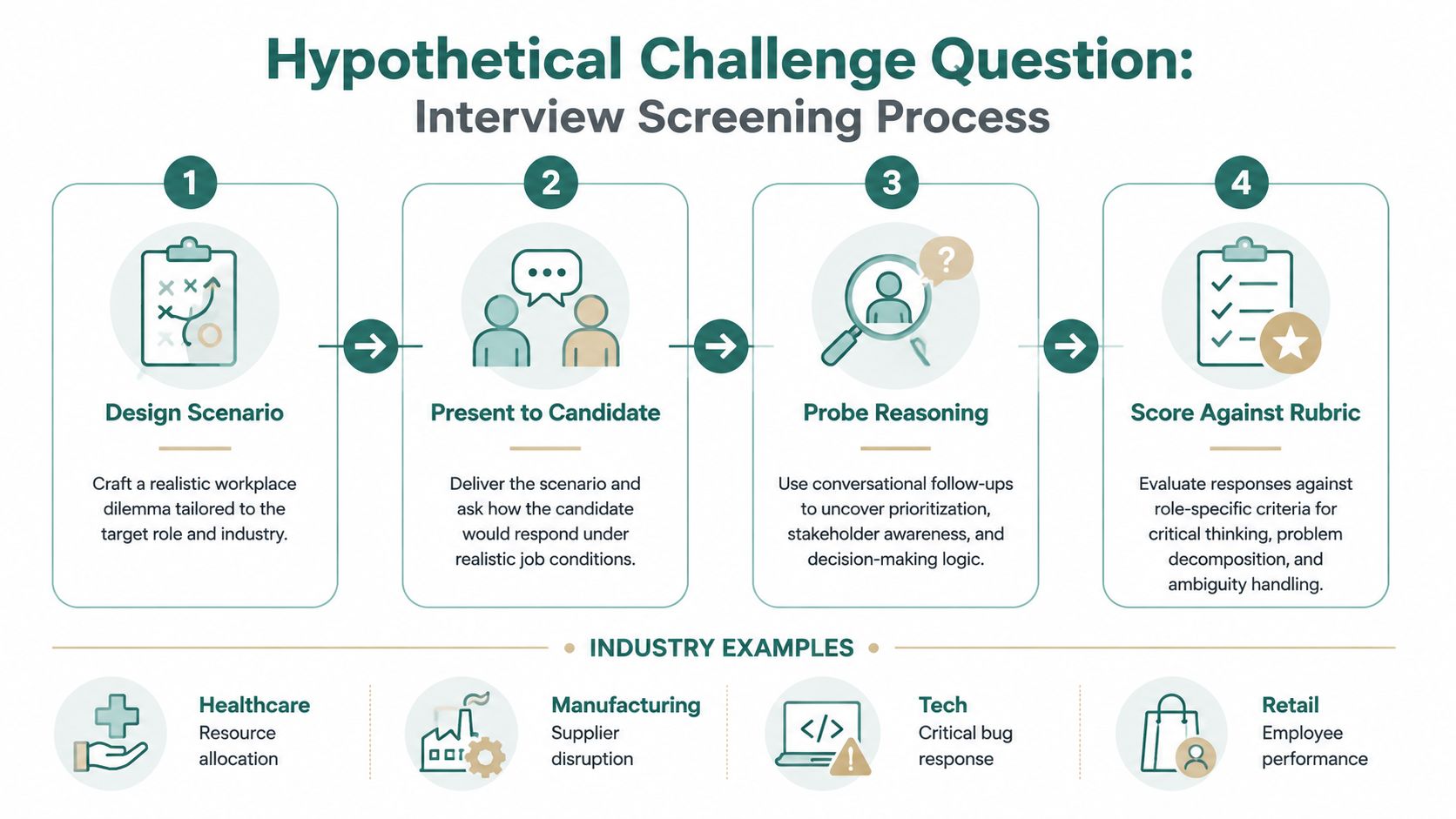
Core question: “A realistic problem has emerged in this role. Walk me through what you'd do first, what information you'd need, who you'd involve, and how you'd decide whether your response was working.”
Hypothetical questions work best when they resemble actual job conditions rather than abstract puzzles. A hospital might ask how a candidate would prioritize resources during a surge in emergency demand. A manufacturer could present a sudden supplier disruption before a major delivery. A technology team might ask how a candidate would respond to a critical product bug affecting users, while a retail manager could address repeated lateness from an otherwise productive employee.
The final answer matters less than the path to it. Candidates should distinguish known facts from unknowns, identify immediate risks, consider affected stakeholders, and explain when they'd escalate. A confident answer that jumps straight to a solution may be less valuable than a measured answer that asks the right questions first.
Ask:
Strong responses show prioritization, risk assessment, proportionate escalation, and a logical link between evidence and action. Weak responses rely on generic phrases such as “I'd communicate with everyone,” offer an ideal solution without constraints, or treat every issue as equally urgent.
For entry-level roles, use a bounded scenario with clear operational limits and assess whether the candidate follows process and seeks help. For managers, introduce competing stakeholders and incomplete information. For executives, expect the candidate to define the problem, establish decision principles, protect long-term consequences, and communicate trade-offs across the organization.
Use a rubric that scores the reasoning process, not whether the candidate gives the answer the interviewer personally prefers. Talent Pronto's scenario-based interview questions can help standardize role-specific prompts and follow-ups during early screening.
Core question: “Describe a time when a process, product, or outcome failed. How did you investigate what caused the problem?”
This question separates symptom management from analytical depth. A candidate who says, “The team needed more training,” may be correct, but the answer is incomplete unless they explain how they tested that conclusion. A strong investigator gathers evidence, compares possible causes, speaks with people close to the work, tests hypotheses, and checks whether the proposed fix changed the underlying condition.
A healthcare candidate might describe a protocol that wasn't working and how they traced the failure. In manufacturing, the example could involve an unexpected rise in product defects. A software engineer could explain how they isolated performance degradation, while a logistics candidate might investigate a fulfillment failure across ordering, warehousing, and delivery.
Look for a sequence such as:
Ask the decisive follow-up: “How did you validate that this was the root cause?” Also ask, “What alternative explanations did you rule out?” A strong answer makes uncertainty visible and may identify several contributing factors. A weak answer guesses quickly, confuses correlation with causation, or treats a convenient explanation as proof.
Give more credit for rigorous reasoning than for naming the “correct” cause by luck. For junior roles, expect organized investigation and appropriate use of established procedures. For senior roles, assess systems thinking, cross-functional evidence gathering, and whether the candidate changed controls, incentives, or workflows to reduce recurrence.
A process-oriented screening workflow can help interviewers compare how candidates define failures, test hypotheses, and communicate findings. Use the following visual as a reminder that a sound evaluation should move from evidence collection to judgment, rather than from a polished story directly to a score.
This video can provide another discussion prompt for interviewers designing process-focused evaluations.
Core question: “Tell me about a time when important priorities conflicted. How did you decide what to protect, what to delay, and how to explain the trade-off?”
Every workplace has competing demands. The signal here isn't speed or decisiveness. It's whether the candidate can make a defensible choice while recognizing that one group may bear a cost.
A hospital candidate might discuss allocating a scarce critical-care resource under established ethical and clinical rules. A manufacturing supervisor could explain why a customer request couldn't justify bypassing safety protocols. In technology, the example might involve balancing existing commitments against a strategic project. In hospitality, a candidate could explain how they handled a VIP complaint without violating a core policy.
Probe with:
Strong answers name constraints, distinguish urgent from important, consider safety or ethics, and communicate directly with affected parties. Weak answers only satisfy the loudest stakeholder, describe compromise without explaining the reasoning, or present decisiveness as a substitute for judgment.
The interviewer shouldn't score based on whether the candidate chose the interviewer's preferred outcome. Score the transparency of the reasoning, the clarity of the values involved, and the candidate's ability to acknowledge consequences.
An individual contributor should show sound prioritization within their authority and timely escalation. A manager should balance team capacity, customer commitments, and organizational risk. A senior leader should explain decision principles, create alignment among stakeholders, and accept accountability for consequences.
For consistent evaluation, pair the question with a predefined rubric and use the same follow-ups across candidates. This decision-making interview resource can help interviewers build role-specific variations without turning the assessment into an improvised conversation.
Core question: “Before taking action on this problem, what assumptions would you make, and how would you test them?”
Sound judgment starts with knowing what isn't known. This question reveals whether candidates can separate facts, interpretations, and guesses before committing time or resources.
A software candidate might identify assumptions about the cause of slow API responses and explain which logs or tests would validate them. In healthcare, the candidate could outline what they'd need to understand before implementing a patient-safety protocol. A manufacturing applicant might distinguish equipment, material, staffing, and process assumptions when production yield falls. In pharma, the answer should address how evidence would be gathered before major investment.
Ask candidates to name assumptions explicitly. Then use focused probes:
Strong answers acknowledge uncertainty, rank assumptions by risk, and propose practical validation steps. They don't need to choose the assumptions the interviewer had in mind. The quality lies in their ability to identify plausible alternatives and explain how evidence would update their view.
Weak responses present assumptions as facts, list data without explaining how it would affect the decision, or insist that more information is always needed before action. Excessive caution can be as problematic as overconfidence, particularly in roles where teams must make reversible decisions while learning.
For junior applicants, ask for a simple distinction between what they know and what they'd verify. For experienced specialists, expect technical or operational validation. For senior leaders, assess whether they can identify strategic, ethical, financial, and stakeholder assumptions, then establish a decision process that makes uncertainty visible.
Score validation rigor, not assumption correctness. A thoughtful candidate may begin with an imperfect hypothesis and improve it through testing. That reasoning pattern is more valuable than a polished answer built around hindsight.
Core question: “Tell me about a problem that required people from different functions to work together. Where did perspectives conflict, and how did you help the group reach a decision?”
Cross-functional work reveals whether candidates understand systems beyond their own responsibilities. It also exposes a critical distinction between advocating effectively and listening well.
A healthcare applicant might describe coordinating clinical, administrative, and support teams. In manufacturing, engineering, operations, and supply chain may disagree about priorities. A technology candidate could discuss tension among product, engineering, and design. In hospitality, the example might involve front-of-house, back-of-house, and management resolving an operational issue.
The best answers explain why other groups held different views. They don't reduce disagreement to one side being difficult. Candidates should describe how they gathered context, translated technical or operational concerns, and adjusted their own position when new information emerged.
Use these follow-ups:
Strong answers show listening, clear communication, shared problem definition, and willingness to change course. Weak answers focus on “winning,” portray colleagues as obstacles, or claim alignment without describing how it was built.
Practical rule: Score how the candidate improved the group's reasoning, not how forcefully they defended their own idea.
For early-career candidates, look for respectful collaboration and accurate escalation. For managers, expect them to structure disagreement, clarify decision rights, and protect relationships. For senior leaders, assess whether they can align functions around enterprise-level outcomes without erasing legitimate specialist concerns.

Core question: “Describe a time when you had to deliver a meaningful result with limited time, budget, staff, information, or authority. What did you prioritize, and what did you knowingly give up?”
Constraints make reasoning visible because candidates can't claim to optimize everything. The useful signal is not how severe the limitation was. It's whether the candidate understands trade-offs, works within legitimate boundaries, and owns the consequences of prioritization.
A healthcare applicant might describe maintaining care quality with limited staffing. A manufacturing candidate could explain delivering a project with fewer resources than planned. A startup engineer might discuss building a product with a small team and limited budget. A government candidate could address regulatory requirements alongside strict resource limits.
Ask:
Strong answers prioritize explicitly, seek help appropriately, find workable alternatives, and explain what they sacrificed. They don't confuse improvisation with ignoring safety, compliance, or quality controls.
Weak answers spend the story complaining about the constraint, imply that success required unlimited effort, or hide the costs of their decisions. A candidate who says everything remained perfect may not understand the constraint at all.
For junior roles, assess practical resource use and willingness to ask for help. For mid-level roles, expect independent prioritization and clear communication about risk. For senior roles, look for the ability to renegotiate scope, align stakeholders, protect critical controls, and make constraints visible before they become failures.
Use outcomes as evidence, but don't score candidates by the size of the budget or team they had. Score the quality of their choices, the realism of their plan, and their ownership of consequences.
Core question: “Tell me about a significant mistake or failure. What did you learn, and what changed in your behavior or process afterward?”
A useful failure answer isn't a performance of vulnerability. It's evidence that the candidate can examine their own reasoning without collapsing into blame or self-protection.
In healthcare, the example might involve a clinical or operational error and the controls introduced afterward. A manufacturing candidate could discuss a missed target. A technologist might explain a technical failure that changed their approach to testing or release management. A leader could reflect on a management decision that produced an unintended result.
Listen for a clear distinction between accountability and blame. Candidates who say “I” when describing their decision, then identify the conditions that influenced it, usually provide more useful evidence than candidates who describe failure only through passive phrases about what “happened.”
Probe with:
Strong answers identify the decision, acknowledge impact, explain the lesson, and show a concrete change. Weak answers choose a harmless weakness, blame circumstances entirely, or end with “I learned to be more careful” without evidence of changed behavior.
Don't reward the most severe failure. A small but consequential mistake can reveal better reflection than a dramatic story with no personal ownership. For junior candidates, look for honesty, learning, and appropriate escalation. For senior candidates, expect systemic improvements, transparent communication, and an understanding of how leadership decisions shape team behavior.

Core question: “Describe a decision or process change you influenced. How did it affect customers, colleagues, leaders, and other groups, including anyone you didn't initially consider?”
A decision can solve the visible problem while creating hidden costs elsewhere. This question tests whether candidates think in systems, anticipate ripple effects, and take responsibility for people who aren't in the room.
A healthcare candidate might discuss a policy change affecting patients, staff, and operations. In manufacturing, a safety or quality improvement could alter work for production, maintenance, and commercial teams. A technology applicant could explain how a product decision affected users, engineering capacity, and business priorities. In retail, a scheduling change may influence employees, customers, and store performance.
Ask candidates to name stakeholder groups rather than saying “everyone.” Follow with:
Strong answers distinguish direct and indirect effects, acknowledge limitations, and show that stakeholder input influenced the decision. Weak answers discuss only the intended beneficiary, treat adoption as proof of success, or describe empathy without any action.
For junior roles, use a contained process change and assess whether the candidate considers coworkers and customers. For managers, expect active stakeholder mapping, communication planning, and mitigation of foreseeable harm. For senior leaders, look for enterprise consequences, equity and compliance considerations, and willingness to revisit a decision when the impact differs from the forecast.
Score breadth and depth separately. A candidate who names many stakeholders but offers no meaningful analysis hasn't demonstrated systems thinking. A candidate who identifies fewer groups but explains the trade-offs and response clearly may provide stronger evidence.
Core question: “Tell me about a project where requirements, expectations, or goals were unclear or changed. How did you create enough structure to move forward?”
Ambiguity tests initiative without requiring candidates to enjoy chaos. Strong performers don't wait passively for perfect instructions, but they also don't hide assumptions behind confident action. They clarify the objective, identify decision boundaries, establish milestones, and communicate when their interpretation may be wrong.
A technology candidate might describe shifting product requirements. In healthcare, the example could involve a major organizational change with unclear direction. A manufacturing applicant might discuss implementing a new process before expectations were fully defined. In a startup, the candidate could explain how they remained productive while strategy changed.
Ask:
Strong answers create a working plan, use milestones or checkpoints, communicate uncertainty, and revise the plan as evidence changes. Weak answers either wait for instructions, proceed on untested assumptions, or describe constant change as an excuse for poor follow-through.
For early-career roles, assess whether the candidate asks focused questions and escalates responsibly. For experienced roles, expect them to turn ambiguity into a decision framework and keep stakeholders aligned. For senior leaders, look for the ability to define direction while preserving flexibility, explain what is known and unknown, and prevent uncertainty from spreading through the organization.
Score adaptability and structure separately. Comfort with ambiguity alone isn't a competency. The stronger signal is whether the candidate can make progress while keeping decisions traceable and reversible where possible.
| Question type | 🔄 Complexity | ⚡ Resources & setup | ⭐ Expected effectiveness | 📊 Ideal use cases | 💡 Key advantage / tip |
|---|---|---|---|---|---|
| The Behavioral STAR Method Question | Medium, structured narrative with consistent scoring | Medium, needs rubrics, scoring training; automatable | ⭐⭐⭐, strong evidence of past behavior | Screening for judgment, adaptability; high-volume hiring | 💡 Standardize rubrics; probe to complete STAR elements |
| The Hypothetical Challenge Question | Medium, requires realistic scenario design | Medium, role-specific scenarios and rubrics | ⭐⭐, good for reasoning; can elicit rehearsed answers | Context-specific problem solving (consulting, tech, ops) | 💡 Calibrate scenarios and focus scoring on reasoning process |
| The Root-Cause Analysis Question | High, deep analytical probing and validation | Medium–High, needs domain expertise and structured probes | ⭐⭐⭐, differentiates analytical depth and systems thinking | Quality, operations, technical troubleshooting, compliance | 💡 Probe investigation steps and evidence used to validate causes |
| The Conflicting Priorities Question | High, nuanced, culture-dependent evaluation | Medium, requires value-aligned rubrics and skilled evaluators | ⭐⭐⭐, strong signal for judgment and leadership | Leadership, supervisory roles, ethical decision contexts | 💡 Score transparency of tradeoffs and stakeholder consideration |
| The Assumption-Testing Question | Medium, meta-cognitive and hypothesis-focused | Medium, benefits from domain context; structured prompts | ⭐⭐⭐, excellent for evidence-based and technical roles | R&D, product, strategy, technical decision-making | 💡 Ask candidates to name assumptions and how they'd test them |
| The Cross-Functional Collaboration Question | Medium, evaluates interpersonal nuance and alignment | Low–Medium, relies on behavioral examples and probing | ⭐⭐⭐, high value for teamwork and matrix environments | Matrix orgs, healthcare, product & cross-discipline projects | 💡 Listen for perspective-taking and consensus-building actions |
| The Constraint Navigation Question | Medium, practical tradeoff evaluation | Low, easy to implement with concrete prompts | ⭐⭐, reveals resourcefulness and prioritization | Startups, nonprofits, government, resource-limited contexts | 💡 Score creative tradeoffs and learning, not just outcomes |
| The Failure Reflection Question | Medium, needs psychological safety to surface honesty | Low, simple to ask; requires skilled follow-up | ⭐⭐⭐, strong for maturity, accountability, growth mindset | Leadership development, learning-oriented cultures | 💡 Prefer "I" statements and concrete behavior changes learned |
| The Stakeholder Impact Question | Medium, systems-level and multi-perspective analysis | Medium, asks for multiple stakeholder lenses | ⭐⭐, shows empathy and ripple-effect awareness | Customer/patient-facing roles, leadership, policy work | 💡 Require naming multiple stakeholders and unintended consequences |
| The Ambiguity Navigation Question | Medium, assesses structuring and adaptation under change | Medium, scenario/context to reflect real ambiguity | ⭐⭐⭐, critical for fast-moving or innovative organizations | Startups, product development, change management | 💡 Look for proactive clarification and ability to create structure |
Ten thoughtful questions won't improve hiring if interviewers score them differently. Begin by defining the competencies that matter for the role, such as root-cause analysis, prioritization, accountability, stakeholder awareness, or evidence evaluation. Then choose a balanced subset of questions that tests those competencies from different angles. A candidate may sound strong in a behavioral story but struggle with ambiguity or assumption testing, so relying on one question type creates blind spots.
Write standardized follow-up prompts before interviews begin. The prompts should request evidence, not coach candidates toward a preferred answer. “What did you know at the time?” and “What would have changed your mind?” are more revealing than repeated requests to “tell me more.” Keep the core question, follow-ups, time expectations, and scoring criteria consistent across candidates.
Structured interviews support fairness when employers ask each candidate the same predetermined questions and score responses with a consistent rating scale. SHRM's unbiased interview checklist recommends standardized questions, objective scoring, and inclusive panels. Consistency doesn't mean ignoring relevant context. It means changing the context deliberately for the role, not changing the standard because one candidate feels more familiar or charismatic.
Anchor each score to observable evidence. A strong rating might require the candidate to identify assumptions, compare alternatives, explain stakeholder effects, and describe how they validated the result. A weak rating might reflect unsupported certainty, vague ownership, missing outcomes, or reliance on authority without reasoning. Don't confuse polished communication with sound judgment. Communication helps an interviewer understand reasoning, but fluency isn't proof that the reasoning is valid.
Calibrate reviewers with sample answers or anonymized response excerpts. Discuss why a response earned its rating, which evidence was missing, and whether the rubric rewards the competency rather than a particular personality or communication style. Seniority should change the expected scope, stakeholder complexity, autonomy, and ownership, not the basic fairness standards. A junior employee may appropriately escalate a decision, while a senior leader should establish the decision framework. Both should explain their reasoning and do so in a job-relevant manner.
Tailor scenarios to healthcare, manufacturing, logistics, hospitality, retail, government, technology, or another target industry. Avoid irrelevant barriers that measure familiarity with a particular workplace rather than critical thinking. In high-stakes or regulated roles, ask about source credibility, error correction, compliance, auditability, and decision traceability. Modern guidance increasingly emphasizes judgment, adaptability, and ethical decision-making in changing and AI-shaped workplaces, while assessment literature supports scenario-based follow-ups that connect interview reasoning to everyday behavior. See this interview guidance for evolving hiring expectations for additional context.
If you use automated screening, explain the process clearly and provide an opt-out path where applicable. Candidate experience also depends on timely feedback. One candidate-experience source recommends surveying candidates within 24–48 hours of their last interaction and keeping the survey to 5–6 questions that take under two minutes, as described in this candidate-experience metrics guide. Application-stage feedback should be sent immediately or the same day after submission or drop-off, according to this candidate-experience survey resource. These practices don't replace respectful human communication, but they help teams identify friction while the experience is fresh.
Talent Pronto can support this workflow with conversational screening, role- and industry-aware question sets, follow-up probing, structured scorecards, and ATS or HRIS synchronization. Its assistant, Anna, can ask behavioral and technical questions, organize responses against employer-defined criteria, and coordinate early-funnel activity. The platform supports screening consistency, but it doesn't make final advancement or rejection decisions. Employers should retain that responsibility, review evidence, and apply human judgment before moving candidates forward.
Use these questions as a starting point, then validate them against the actual work. You can also explore free skill platforms when designing role-relevant evaluation paths, especially where practical skills need support beyond the interview.
Talent Pronto offers conversational screening for every applicant, role-specific critical thinking questions, follow-up probing, and structured scorecards that Talent teams can review alongside ATS or HRIS data. Visit Talent Pronto to see how it can support consistent early-stage screening while leaving final hiring decisions with your employer team.

Talent Pronto is an AI-powered hiring platform built around Anna, our intelligent AI that conducts 24/7 conversational screening, evaluates candidates against specific job requirements and compliance needs, and schedules interviews. Run everything on the Talent Pronto ATS, our all-in-one applicant tracking system with a branded careers site and Anna built in, or keep your existing ATS and let Anna integrate with Greenhouse, Ashby, iCIMS, Jobvite, Lever, Oracle, and more. Either way, we help organizations reduce time-to-hire and build stronger teams.