Use 8 critical thinking questions for interviews with strong and weak answer cues, follow-up probes, scoring rubrics, and role-specific examples.
Two candidates can sound equally confident in an interview. One gives a polished story, names a successful outcome, and moves on. The other pauses to clarify what was known at the time, identifies assumptions, weighs risks, explains the trade-offs, and shows how evidence changed the decision. That difference is what critical thinking sounds like in an interview.
Critical thinking isn't a personality trait you infer from confidence or vocabulary. It's observable reasoning. You can assess how candidates define a problem, request information, test assumptions, compare options, respond to uncertainty, and learn from consequences. The eight question types below cover behavioral evidence, problem-solving, prioritization, root cause analysis, stakeholder management, failure and learning, assumption awareness, and conflicting information.
The questions work best when every candidate receives comparable prompts, consistent follow-up probes, and a role-specific rubric. Talent Pronto is one relevant example of conversational screening that can ask follow-ups and prepare structured scorecards. Employers still retain advancement and rejection decisions. This article focuses on practical evidence, not polished delivery, and it won't include authored-byline tool credit at the bottom.
Past behavior gives interviewers something concrete to examine. Ask, “Tell me about a time you faced a difficult operational problem. What was happening, what were you responsible for, what did you do, and what happened afterward?” The candidate's response should separate the situation, task, action, and result, rather than blend them into a general success story.
A strong answer identifies the constraint, clarifies the candidate's personal responsibility, explains why a particular action made sense, and connects the action to an outcome. A weak answer stays at team level, uses vague phrases such as “we fixed it,” or treats the result as proof that the reasoning was sound without explaining what information supported the decision.
Use prompts that reflect the work:
Score the reasoning, not the candidate's storytelling style. Look for a clearly defined problem, relevant evidence, deliberate action, awareness of alternatives, ownership, and reflection. A strong response can still describe an imperfect result if the candidate recognized risk and adjusted responsibly.
Ask, “Why did you choose that approach?” and “What other options did you consider?” Follow with, “What would you do differently now?” These probes expose whether the candidate remembers a rehearsed narrative or can reconstruct the decision process.
For a deeper guide to consistent use of the framework, see Talent Pronto's STAR method for interviewing.
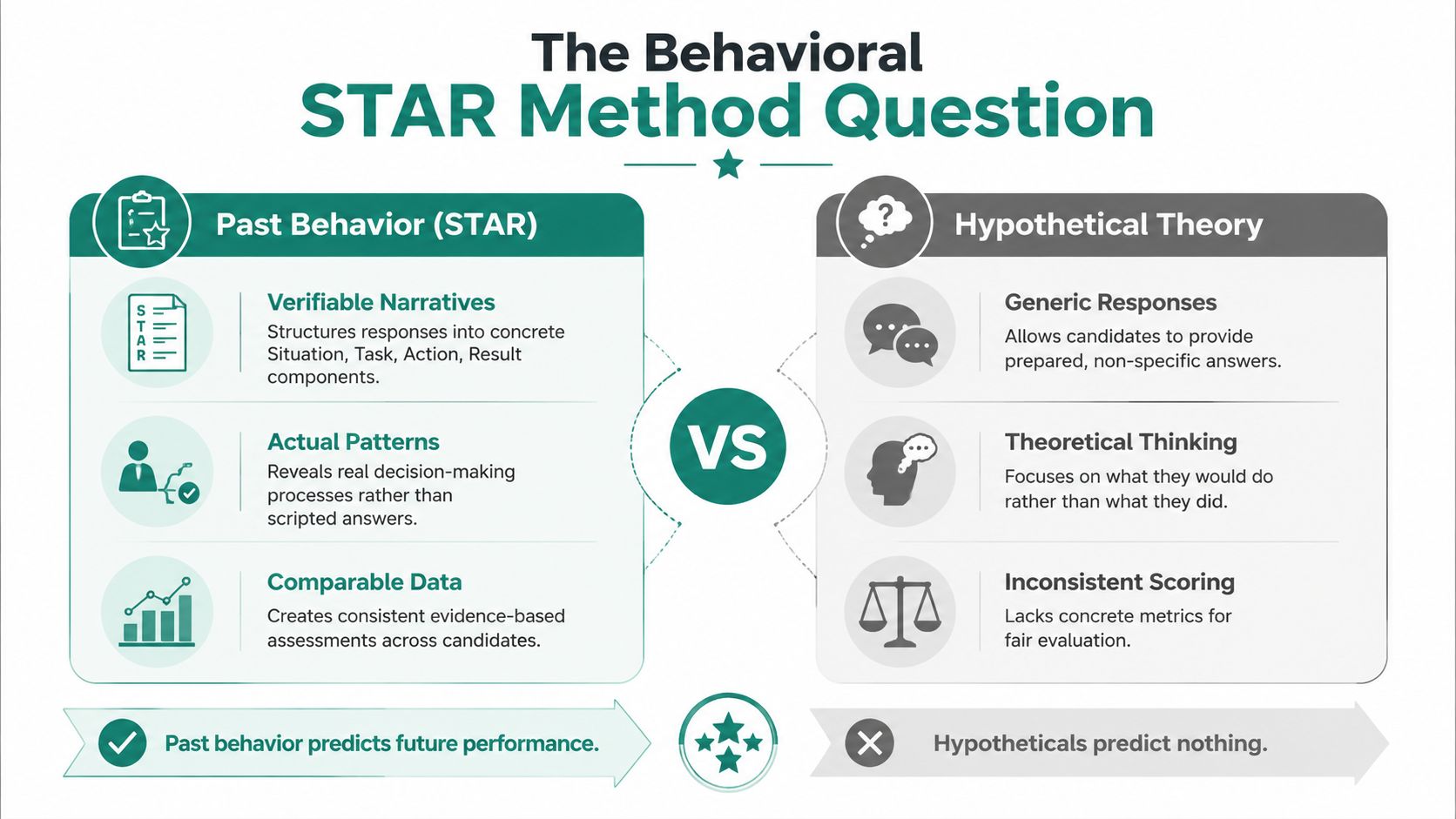
A structured or automated screen can present the same role-specific STAR prompt to every applicant, ask the same approved probes, and capture evidence against predefined criteria. That improves comparability, but the scorecard should still distinguish a specific reasoning signal from fluency, accent, speed, or familiarity with interview conventions.
A scenario question tests what a candidate does with a problem they haven't already solved. Give enough context to make the situation realistic, then leave room for the candidate to ask questions before recommending action.
For a healthcare role, ask, “A medication order may conflict with the patient's current medications. You aren't the prescribing physician. What's your first step, and how do you think through the situation?” In manufacturing, use a shipment that fails quality specifications shortly before production. In technology, ask about a critical production bug shortly before a client demonstration. Public-sector candidates might address a department reduction caused by budget cuts, while hospitality candidates might respond to an unexpected absence during the busiest shift.
The strongest candidates don't rush toward an answer. They identify immediate safety or service risks, ask what authority they have, request missing facts, separate reversible from irreversible actions, and explain how they'd communicate the decision. Weak answers jump to a solution, assume facts not provided, or offer generic statements about “staying calm” without a sequence of actions.
Use neutral probes such as “What would you do next?” and “What else would you consider?” Don't lead the candidate toward your preferred answer. You're evaluating the quality of the process, including what the candidate notices before acting.
A useful rubric can score:
Scenario difficulty should match the role. An entry-level candidate may need to identify escalation points and follow procedures. A leader may need to allocate resources, protect stakeholders, and make a decision with incomplete information.
For more examples of designing realistic prompts, review Talent Pronto's scenario-based interview questions.

In conversational screening, the system can ask an approved follow-up after the initial response rather than treating the first answer as complete. The employer should define acceptable evidence in advance and review how the rubric behaves across roles before relying on automated recommendations.
Prioritization reveals what candidates value when every request can't be handled at once. Ask them to rank competing demands and explain the criteria behind the ranking. The answer matters less than whether the candidate can make a transparent, defensible choice.
Consider a technology prompt: “You have three feature requests, limited development resources, and pressure from product and sales leadership. How would you prioritize?” A healthcare manager might balance high patient volume, staffing shortages, and mandatory training. A manufacturing candidate could weigh quality problems against pressure to increase output. In retail or hospitality, reduced operating hours may collide with customer requests and employee scheduling needs. A pharma or biotech candidate might have regulatory timelines, resource conflicts, and emerging technical issues.
Strong reasoning starts with explicit criteria, such as safety, regulatory exposure, customer impact, urgency, reversibility, or strategic value. Strong candidates also say what they would postpone, what risk that creates, and how they'd communicate the decision. Weak answers only choose the loudest stakeholder, treat urgency as the only criterion, or promise to complete everything without acknowledging constraints.
Ask, “What are you deprioritizing, and why?” Then probe with, “What could go wrong with your approach?” and “How would you know the decision worked?” These questions reveal whether the candidate understands second-order consequences rather than only immediate pressure.
Practical rule: A prioritization answer isn't strong because it sounds decisive. It's strong when another interviewer can follow the criteria, challenge the assumptions, and reach a comparable evaluation.
Your scorecard can assess whether the candidate:
Automated conversational screening can standardize the scenario and collect the same trade-off probes for every applicant. It shouldn't flatten role differences. A warehouse supervisor, a clinical coordinator, and a software engineer need different constraints, escalation paths, and evidence standards.
A candidate who can stop a problem isn't necessarily able to prevent it from returning. Root cause questions test whether the person investigates before assigning blame or applying a quick fix.
Ask, “Product defect rates have increased. How would you find out why?” A healthcare version might involve rising medication errors on an evening shift. In technology, ask how the candidate would diagnose degraded system performance. A pharma or biotech candidate could investigate a failed batch test. Retail and hospitality teams might examine unexpected turnover, while public-sector candidates could analyze rising complaints about service delays.
Strong candidates begin by defining the pattern. They ask whether the increase is real, how it was measured, when it began, which teams or locations are affected, and what changed around the same time. They separate possible causes, form hypotheses, test them with relevant evidence, and avoid assuming that the person closest to the incident caused it.

Ask what information the candidate needs before forming a hypothesis. Follow with several “Why?” prompts, using the 5 Whys approach as a way to explore underlying causes rather than accept the first explanation. Listen for process, training, equipment, workload, communication, measurement, and environmental factors where they plausibly apply.
A weak answer blames an individual immediately, relies on anecdotes, or recommends more training without examining whether training explains the pattern. Another warning sign is confusing correlation with causation. A candidate might notice that errors rose after a schedule change, but should still test whether the schedule caused the errors.
Use a rubric with anchors for evidence gathering, hypothesis breadth, causal reasoning, assumption awareness, and corrective action. In an automated screen, the follow-up should ask the candidate to name the evidence that would confirm or weaken their leading explanation. The system can organize the response, but reviewers should verify that the underlying prompt and scoring criteria fit the role.
A final probe such as “What would you change so the issue is less likely to recur?” distinguishes a temporary workaround from systems thinking.
Critical thinking becomes visible in how candidates handle disagreement. Ask, “Operations wants speed, quality assurance wants more testing time, and customers want faster delivery. How would you manage this?” The candidate must reason about competing interests without reducing the situation to a contest between the most senior voices.
Role-specific variations make the evidence more useful. In healthcare, a new workflow might have administrative support but face resistance from nursing staff. In technology, engineering may want to refactor legacy code while product wants new features and leadership wants lower costs. A government candidate might coordinate agencies with different mandates. Retail, hospitality, pharma, and biotech roles can use scenarios involving policy changes, project timelines, or competing departmental requirements.
Strong answers begin with listening. Candidates should identify what each group is protecting, distinguish legitimate constraints from preferences, and explain how they'd tailor communication. They might use data, precedent, risk analysis, or a small test to build support. Weak responses impose a decision, promise universal agreement, or use vague language about “getting everyone on the same page.”
Ask how the candidate would communicate with each stakeholder group differently. Then ask, “What would you do if someone still disagreed after you've heard their concerns?” This reveals whether the candidate can make a decision without pretending disagreement has disappeared.
Score for:
Conversational screening can present the same stakeholder conflict and probe for listening, trade-offs, and escalation. Automated scoring should reward concrete reasoning, not agreeable language. A candidate who respectfully rejects an unsafe shortcut may demonstrate stronger judgment than one who claims they can satisfy every stakeholder.
Ask, “Tell me about a significant mistake or setback. What happened, what part did you play, and what changed afterward?” This question is useful only when the interviewer examines the learning process. Candidates can rehearse a harmless weakness, so a polished confession alone isn't evidence of self-awareness.
Healthcare candidates might discuss a patient-care error or clinical misjudgment. Manufacturing candidates could describe an overlooked quality issue. Technology candidates might explain shipping code with a bug. Retail and hospitality candidates might address a customer-service failure or team conflict. Pharma, biotech, and government roles can explore a missed compliance requirement or a policy implementation that didn't go as planned.
A strong answer identifies the candidate's contribution without ignoring system conditions. It explains the evidence behind the lesson, names a specific change in behavior or process, and shows whether that change was applied later. A weak answer blames external factors exclusively, chooses an inconsequential example, or ends with “I learned to communicate better” without showing what communication changed.
Ask, “What specifically did you learn?” Then ask, “How did you apply that learning?” A further probe, “Have you faced something similar since, and what did you do differently?” tests whether the lesson became a repeatable practice.
Look for safeguards, not just intentions. A candidate who added a review step, changed an escalation rule, improved documentation, or created a clearer handoff demonstrates more than someone who says they'll be more careful.

A structured scorecard should separate accountability, causal analysis, specificity of learning, and evidence of changed behavior. Automated screening can ask the same follow-ups consistently, but employers should avoid treating emotional openness or dramatic storytelling as a proxy for reasoning quality. The most useful answer may be calm, factual, and modest.
Candidates make decisions from assumptions, often without noticing them. Ask, “Tell me about a time you were confident in an interpretation or approach that turned out to be wrong. What evidence changed your view, and what did you do next?”
For healthcare, the prompt might address an initial diagnosis or assumption about a patient's condition. Manufacturing candidates can discuss assumptions about a process or colleague. Technology candidates might explain why an expected technical approach failed. Retail, hospitality, and public-sector candidates can examine assumptions about customers, team members, policies, or community needs. A general version asks when a candidate recognized that their perspective was limited by their background or experience.
Strong candidates can name the original assumption, identify the evidence that challenged it, and describe a change in action rather than merely a change in attitude. They may explain how they now seek input from people with different experience or test an interpretation earlier. Weak answers claim they rarely make assumptions, describe bias only as something other people have, or present a reversal without explaining the evidence.
Ask, “What would have helped you identify the assumption sooner?” Then probe, “How do you challenge your own thinking before it fails?” This distinguishes candidates who learn only after consequences from those who build review habits into their decisions.
Score for intellectual humility, evidence use, perspective seeking, behavioral change, and relevance to the role. In hiring, that may include how the candidate thinks about patient demographics, fairness in selection, or technology design. Don't ask candidates to disclose protected personal information. Keep the question focused on observable decision-making.
For related employer practices, Talent Pronto's unconscious bias training resource can support broader discussion, but interviewers still need a role-specific rubric.
In automated conversational screening, ask the same evidence-focused probes and review whether the system gives candidates a reasonable opportunity to explain context. A consistent process can support fairness, but consistency alone doesn't prove that the criteria are job-related or free from unintended bias.
Some decisions arrive with incomplete, contradictory, or unreliable information. Ask, “You receive conflicting accounts of a workplace incident, and neither person has provided enough detail to verify what happened. How would you investigate and proceed?”
Use job-specific versions. Healthcare candidates might respond to a possible medication error affecting a patient. Manufacturing candidates could assess preliminary supplier-quality data before production. Technology candidates might prioritize a possible security vulnerability with unclear scope. Pharma and biotech roles can address early test results that contradict previous findings. Government candidates might interpret vague guidance that doesn't fit local circumstances.
Strong reasoning starts with immediate risk. The candidate identifies who could be affected, asks which facts are decision-critical, distinguishes information that changes risk from information that's merely convenient, and creates a provisional plan while gathering evidence. They explain how they'd communicate uncertainty, when they'd escalate, and what would cause them to revise the decision.
Weak answers either freeze until every fact is known or move recklessly with unsupported confidence. Another weakness is collecting information without a criterion for sufficiency. A candidate should be able to say what they need to know, why it matters, and what action is safe while the gap remains.
Ask, “What information would you need to feel confident?” Then follow with, “What would you do if that information wasn't available?” Probe for worst-case scenarios, contingencies, communication, and decision updates as new facts emerge.
A practical rubric can assess:
Automated screening can present a controlled ambiguity scenario, ask standardized follow-ups, and record the candidate's reasoning for review. Keep the scenario accessible to candidates with different communication styles. The score should reflect decision quality and evidence handling, not speed, charisma, or the use of specialized jargon.
| Question Type | 🔄 Implementation complexity | ⚡ Resource requirements | ⭐ Expected effectiveness | 📊 Expected outcomes | 💡 Ideal use cases & quick tip |
|---|---|---|---|---|---|
| The Behavioral STAR Method Question | Moderate, structured prompts + follow-ups | Low–Moderate, interviewer time, scoring rubric; automatable | ⭐⭐⭐⭐, strong for demonstrated competencies | Verifiable narratives; comparable, evidence-based scores | Hiring for decision-making/problem-solving; tip: probe for metrics |
| The Problem-Solving Scenario Question | High, custom realistic scenarios; evaluator expertise needed | Moderate–High, scenario design, calibrated raters, interview time | ⭐⭐⭐⭐, excellent for real-time reasoning | Reveals thinking process, prioritization, trade-offs | Analytical roles (consulting, product, engineering); tip: encourage clarifying questions |
| The Prioritization and Trade-Off Question | Moderate, needs role/context alignment | Moderate, requires understanding org priorities to judge answers | ⭐⭐⭐, strong for strategic judgment | Shows prioritization frameworks, stakeholder awareness | Product, operations, leadership; tip: ask what they deprioritize and why |
| The Root Cause Analysis Question | High, deep probing and iterative questioning | Moderate–High, time, domain-specific scenarios, data-focused prompts | ⭐⭐⭐⭐, highly predictive for quality-focused roles | Demonstrates analytical rigor; reduces recurrence of issues | Quality, safety, engineering; tip: use "5 Whys" and request evidence |
| The Stakeholder Management Question | Moderate–High, assesses interpersonal nuance | Moderate, skilled evaluators; scenario realism important | ⭐⭐⭐⭐, predictive for leadership and cross-functional success | Reveals EI, influence approach, consensus-building ability | Leadership, customer-facing, cross-functional roles; tip: ask how they'd tailor communication |
| The Failure and Learning Question | Low–Moderate, straightforward prompt with follow-ups | Low, needs probing to assess depth and authenticity | ⭐⭐⭐⭐, predictive of growth mindset and adaptability | Shows accountability, learning, concrete behavior changes | Roles requiring resilience and improvement (healthcare, compliance); tip: probe for specific actions taken after failure |
| The Assumption and Bias Question | Moderate, requires nuance to surface self-awareness | Moderate, evaluator must separate rehearsal from genuine insight | ⭐⭐⭐, valuable for inclusive decision-making | Reveals humility, bias-awareness, openness to diverse input | Leadership, DEI-sensitive, innovation roles; tip: ask what evidence changed their view |
| The Conflicting Information Question | High, ambiguous/contradictory setups required | Moderate–High, scenario prep and subjective evaluation criteria | ⭐⭐⭐⭐, strong for ambiguity-tolerant decision-makers | Shows information‑seeking, contingency planning, risk awareness | Crisis, startup, fast-moving tech or clinical settings; tip: note whether they ask clarifying Qs and plan contingencies |
Better questions won't produce better hiring decisions unless interviewers agree on what counts as evidence. Start by defining the role's critical-thinking competencies. A patient-safety role may require escalation judgment and evidence-based investigation. A manufacturing supervisor may need quality reasoning and constraint management. A software engineer may need debugging discipline, risk assessment, and the ability to update a plan as technical facts change.
Then choose a balanced mix of behavioral and situational prompts. Behavioral questions reveal how candidates acted in real circumstances. Situational questions show how they approach unfamiliar problems. Neither format is sufficient by itself. A candidate can describe past success without explaining the reasoning behind it, while a hypothetical answer can sound thoughtful without proving that the person has applied the judgment at work.
Structured interviews have a strong evidence base. A 1998 synthesis of 85 years of personnel-selection research reported predictive validity of about 0.51 for structured interviews versus 0.38 for unstructured interviews, making structured formats roughly 34% more predictive of job performance in that synthesis. The hiring-research summary also describes more recent large-scale re-analyses reporting about 0.42 for structured interviews versus 0.19 for unstructured interviews, reinforcing the value of standardized questions over informal gut feel. A separate SHRM-published review of candidate assessment methods reports that general mental ability combined with a structured interview had mean validity of .63, while describing unstructured interviews as less useful for predicting job performance.
Write observable scoring anchors for strong, mixed, and weak reasoning. For each question, define at least three reference answers, superior, satisfactory, and unsatisfactory, as recommended in guidance on better structured interviewing. A superior answer might define the problem, request relevant evidence, identify trade-offs, make a defensible choice, and explain how the decision would change with new information. A satisfactory answer may reach a reasonable action but omit one important assumption or consequence. An unsatisfactory answer may jump to conclusions, rely on unsupported claims, or ignore material risk.
Standardize follow-up probes. If one interviewer asks “What else did you consider?” and another accepts the opening answer, the candidates aren't being assessed on the same task. Pilot the rubric with reviewers, compare interpretations, revise ambiguous anchors, and document why a response received its score.
AI is already part of assessment workflows. A 2026 summary citing ResumeBuilder reports that about 64% of employers use AI to review candidate assessments and about 23% use AI to conduct interviews. The recruitment statistics summary presents these figures as evidence that automated early-stage screening is established in major markets. Adoption doesn't remove the need for employer oversight.
Talent Pronto can be relevant where teams need 24/7 conversational screening, role-specific behavioral questions, automated probing, structured scorecards, and ATS or HRIS coordination. Its assistant, Anna, can engage applicants across web and mobile, while employers retain advancement and rejection decisions. Use the platform to make evidence collection more consistent, not to outsource judgment blindly.
Fairness also requires ongoing review. A Human Capital Media report on role-level AI hiring disparities describes a study of 4 million job applications in which an AI hiring tool could pass an aggregate bias audit while still screening out Black and Asian candidates for specific roles. That supports breaking selection rates down by position and demographic group and periodically advancing a random sample of rejected candidates to examine downstream performance.
The UK government's responsible AI recruitment guidance recommends repeating bias audits at regular intervals after deployment. Its definition focuses on assessing system inputs and outputs for bias in the data, decisions, or classifications. The Harvard Law Journal's auditing analysis likewise supports documented criteria, testing, and reviewable decision logic for automated employment tools.
Choose two question types for one role, write the anchors, test the rubric with interview reviewers, and examine the results for consistency and fairness. Refine the prompts before expanding the method across the hiring funnel.
[Talent Pronto offers 24/7 conversational screening, role-specific critical-thinking questions, automated follow-ups, and structured candidate scorecards that can connect with common ATS and HRIS platforms. Visit Talent Pronto to see how its screening workflow can help your team collect more consistent early-stage evidence while keeping final hiring decisions with employers.]

Talent Pronto is an AI-powered hiring platform built around Anna, our intelligent AI that conducts 24/7 conversational screening, evaluates candidates against specific job requirements and compliance needs, and schedules interviews. Run everything on the Talent Pronto ATS, our all-in-one applicant tracking system with a branded careers site and Anna built in, or keep your existing ATS and let Anna integrate with Greenhouse, Ashby, iCIMS, Jobvite, Lever, Oracle, and more. Either way, we help organizations reduce time-to-hire and build stronger teams.