Learn how to rescind a job offer legally and professionally with our step-by-step guide covering timing, risk, communication, and recordkeeping.

You've just learned that a finalist has failed a required background check, or your finance team has frozen the role after the candidate accepted. The hiring manager wants HR to send a quick email and move on. That instinct creates avoidable risk.
How to rescind a job offer depends on the offer's conditions, the jurisdiction, the candidate's reliance, and the reason you can prove. A careful process won't make the conversation comfortable, but it can prevent a difficult hiring decision from becoming a contract dispute, a discrimination claim, or a serious reputational problem.
It's Thursday afternoon. A candidate is due to start on Monday, and a screening provider has returned information that appears inconsistent with the application. At the same time, the hiring manager says the department's funding has been pulled. Two very different reasons now sit behind the same urgent instruction: withdraw the offer.
The first is potentially tied to a stated hiring condition. The second is a business decision outside the candidate's control. Treating them identically is a mistake. A failed condition may support rescission if the offer clearly said employment depended on satisfactory screening, references, credentials, or another requirement. A budget freeze may call for a delayed start, a different role, or a negotiated change before you cancel the hire outright.
Practical rule: Don't let urgency decide the legal theory. Identify the reason first, then choose the action that matches it.
Common triggers include:
The “send an email” approach fails because it often leaves no coherent record of who made the decision, when the decision was made, or whether the stated reason matches the documents. It also gives the candidate no chance to ask whether a condition failed, whether an alternative exists, or whether notice obligations apply.
Speed still matters. Once the decision is final, notify the candidate promptly. Employer-relations guidance recommends acting quickly and giving a straightforward reason so the candidate's losses can be limited, as explained by MRA's guidance on careful offer rescission. If you're reviewing the consequences from the candidate's side, the practical issues around how to break an employment contract provide useful context for understanding why an accepted offer can carry real weight.
The same withdrawal can have very different consequences depending on where the role is based. Start with the jurisdiction, then classify the offer as conditional, unconditional, accepted, or already in force.
In the United States, the baseline is often broader for employers in at-will contexts. An employer can generally rescind an offer for almost any lawful reason, including a failed drug or background check or a business change, provided the decision isn't based on discrimination, retaliation, or another unlawful ground. Candidates often have limited legal recourse unless they can show unlawful conduct, although reliance, misrepresentation, and contract theories can still matter.
Acceptance doesn't automatically eliminate risk in an at-will setting. The exposure rises when the candidate quit a job, relocated, rejected another offer, or incurred costs because the employer made a promise and then acted inconsistently with its records. Bloomberg Law's discussion of rescinded offers emphasizes the need to document the business reason because unsupported explanations can invite bias claims.
The UK distinction is sharper. A conditional offer can usually be withdrawn when the candidate fails a stated condition, such as satisfactory references or a health check. If the offer was unconditional, or the candidate met every condition, the candidate may be able to pursue breach-of-contract remedies.
Discrimination protection can apply from the hiring stage, before employment begins. Acas guidance referenced by GOV.UK identifies nine protected characteristics: age, disability, gender reassignment, marriage and civil partnership, pregnancy and maternity, race, religion or belief, sex, and sexual orientation. Withdrawing an offer because of one of these characteristics can be unlawful. If the contract has already started, the withdrawal may amount to dismissal and trigger notice-related payments.
Canada deserves separate treatment because an accepted offer may be treated like an employment relationship for wrongful-dismissal purposes. Courts may award contractual damages or pay in lieu of reasonable notice, and losses connected to reliance can include relocation expenses, lost benefits, or pension-related losses, as outlined by Nelligan Law's explanation of rescinded offers.
| Jurisdiction | Default Rule | Discrimination Window | Highest Exposure Trigger |
|---|---|---|---|
| United States | Often broad in at-will settings if the reason is lawful | Before and after hiring where protected conduct or status is involved | Reliance, inconsistent reasons, discrimination, or retaliation |
| United Kingdom | Conditional offers are easier to withdraw than unconditional offers | From the hiring stage, before employment starts | Breach of contract, discrimination, or withdrawal after the contract begins |
| Canada | An accepted offer may support wrongful-dismissal treatment | Unlawful discrimination remains prohibited | Notice-related damages and reliance losses |
For roles involving criminal-history screening, review fair-chance requirements before acting. A practical companion resource is fair-chance hiring guidance, especially when the proposed reason involves screening information rather than a straightforward failure of an express condition.
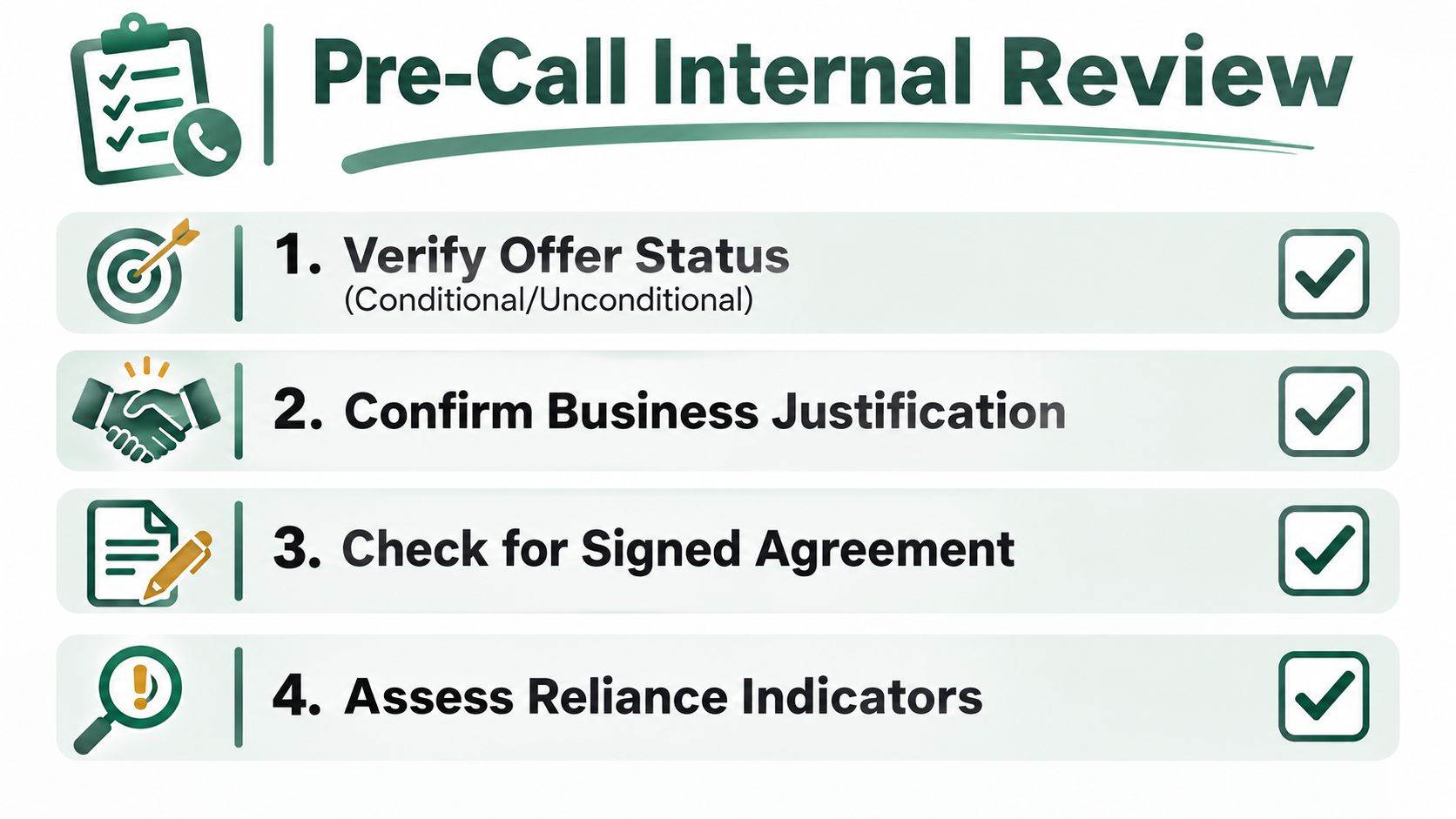
Don't call the candidate until the internal file can answer one question clearly: What lawful, documented reason supports this decision, and what exactly does the offer allow you to do?
Pull the signed or issued offer letter, acceptance record, job description, screening notices, and any related agreement. Mark the conditions in plain language. You need to know whether the offer was conditional, whether every condition was satisfied, whether the candidate accepted, and whether the employment contract has already begun.
An offer that says “subject to satisfactory references” is different from one that promises employment without contingencies. An accepted offer is also different from an offer that's still open. Don't rely on a hiring manager's memory when the written terms are available.
Write the reason in one sentence without adjectives or speculation. “The required professional credential wasn't obtained by the stated deadline” is defensible if the file supports it. “The candidate no longer feels like the right fit” is not a sufficient operational explanation for a high-risk withdrawal.
Then ask:
A legal or compliance review should assess whether the company should rescind, renegotiate, or delay the start. Employer guidance recommends confirming the offer terms, reviewing policies, preserving records, and consulting counsel when an accepted offer is involved. ADP's employer guidance on rescinding an offer is useful for framing that review.
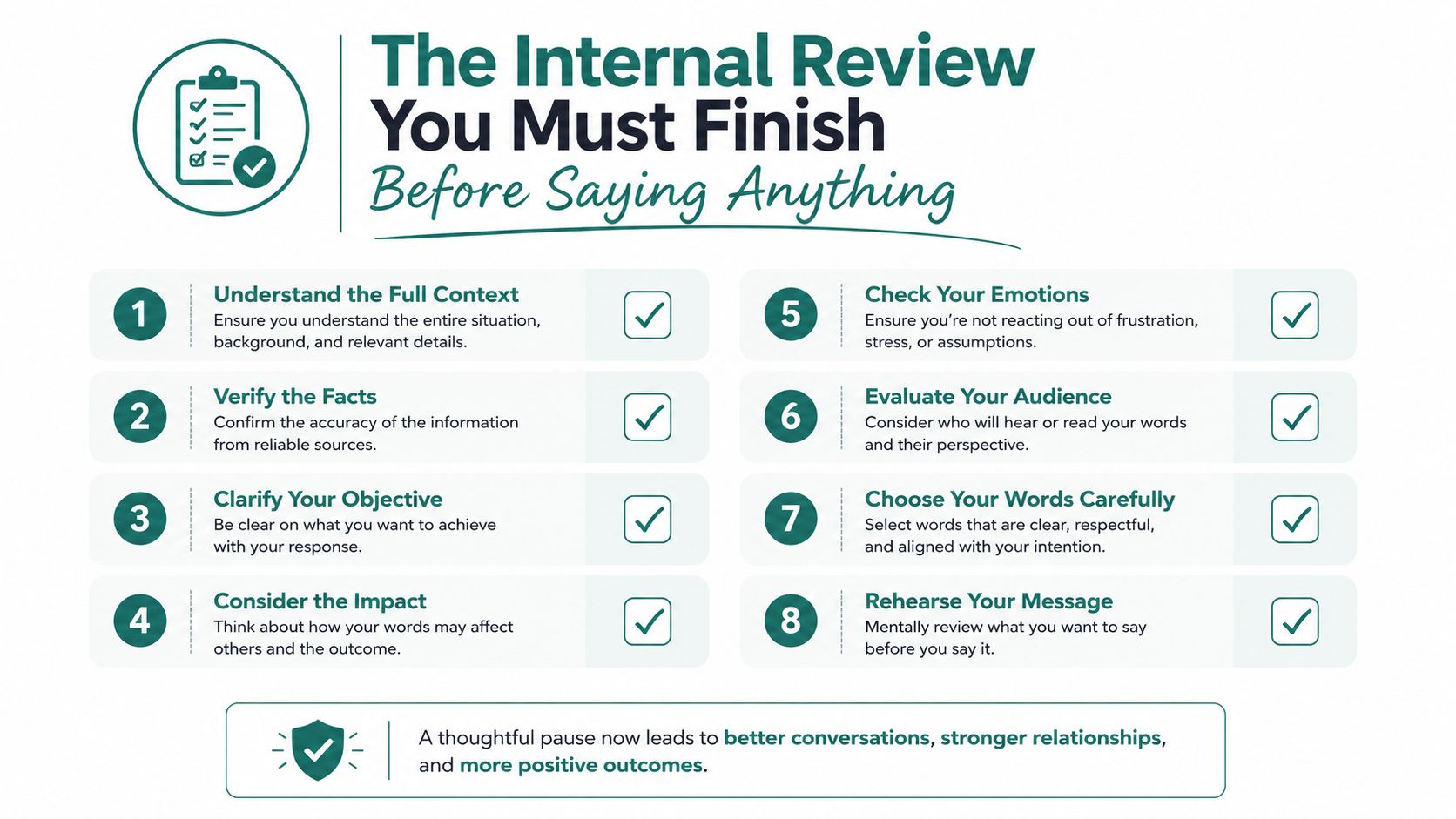
The approval shouldn't be a verbal nod. Save a short decision memo identifying the offer status, the evidence reviewed, the decision-maker, the lawful business reason, the alternatives considered, and the planned communication. That memo is not bureaucracy. It's the company's contemporaneous explanation before memories and narratives change.
A rescission should be delivered by phone or in person first, then confirmed in writing promptly. An email without a conversation feels evasive, deprives the candidate of immediate clarification, and often produces an emotional reply that could have been avoided with direct communication.
Keep the call short. Don't improvise, blame another department, or offer theories that aren't in the internal record.
“I'm calling about your offer for the [role] position. I'm sorry to tell you that we're withdrawing the offer, effective today. The decision is based on [specific documented reason]. I understand this is disappointing, and I'll send written confirmation with the details and a contact for follow-up questions.”
If the reason is a failed condition, identify the condition accurately:
“The offer was conditional on [condition], and our review determined that the condition wasn't met. The written notice will explain the relevant term and the next contact point.”
If the reason is a business change, don't pretend the candidate caused it:
“This decision results from a change in our staffing and budget plans. It isn't a judgment about your qualifications or conduct.”
Subject: Update regarding your [role] offer
Hello [Candidate Name],
Thank you for your time throughout the hiring process. This email confirms that [Company] is withdrawing the offer for the [role] position, effective [date].
The reason for the decision is [accurate, specific reason]. [If applicable: The relevant offer condition was [condition], and our records show that it wasn't satisfied.]
Please direct questions or requests for clarification to [name, title, email, phone]. Please treat this communication and the related hiring information as confidential, subject to your legal rights and any applicable disclosure or challenge process.
We're sorry for the disruption this may cause.
Regards,
[Name]
[Title]
For an accepted offer, don't use a casual cancellation notice. The message should state that the company is ending the arrangement and explain any notice, payment, severance, or settlement steps only after they've been reviewed for the applicable jurisdiction.
Avoid references to age, family plans, pregnancy, health, disability, religion, race, sex, sexual orientation, gender identity, or any other protected characteristic. Don't write “we need someone younger,” “your medical needs won't work here,” or “the team isn't comfortable with your background.” Those phrases create risk even when the decision had another legitimate basis.
Treat the candidate's experience as an operational signal, not a vanity metric. Guidance on candidate experience metrics can help HR teams examine where unclear conditions, late decisions, and poor communication originate.
Withdrawal is only one of three practical choices. The right path depends on whether the job disappeared, the terms changed, or the candidate failed a genuine requirement.

Choose rescission when the candidate failed a clear condition, materially misrepresented qualifications, or the role cannot legally or operationally proceed. The evidence should be specific enough that another HR professional could understand the decision without asking the hiring manager to reconstruct the story.
Rescission is a poor response to a temporary budget problem. It's also excessive when a reference is ambiguous, a résumé discrepancy is minor, or the role can be redesigned without undermining the business need.
Renegotiation makes sense when the company still wants the person but can't deliver the original package. That might mean changing the reporting line, adjusting responsibilities, moving from remote to onsite work, or revising the start conditions.
Put the revised terms in writing and give the candidate a real choice. Don't present a materially worse deal as though nothing changed, and don't pressure the candidate to accept immediately. A clear renegotiation can preserve trust where a cancellation would destroy it.
A delayed start fits a temporary hiring pause, a restructuring process, or a short-term headcount issue. It only works if the candidate agrees and receives a clear written understanding of what remains unchanged, what may change, and when the parties will revisit the arrangement.
The decision criteria are simple:
Renegotiation and delay aren't ways to avoid an uncomfortable decision. They're tools for preserving a viable hire when the underlying employment need still exists.
The withdrawal itself isn't always the biggest risk. The costly part often comes from what the candidate did after receiving the offer.
A candidate may have resigned from a current job, rejected another opportunity, signed a lease, moved, or paid for professional requirements. NACE identifies potential theories including promissory estoppel, fraudulent misrepresentation, breach of contract, and discrimination, while Bloomberg Law emphasizes that unsupported rescission reasons can create bias exposure. The practical question is whether the candidate relied on a promise and whether the employer knew, or should have understood, that reliance was likely.
Reliance becomes harder to dismiss when the employer encouraged the action or knew it had happened. A relocation discussion, a confirmed start date, onboarding instructions, or a request to give notice can matter because they show the company understood the candidate was acting on the offer.
Keep the facts separate from conclusions:
Canada can present especially serious consequences after acceptance, because courts may treat the withdrawal like wrongful dismissal and consider notice and reliance-related losses. In the United States, at-will treatment may limit some claims, but it doesn't make inconsistent records or discriminatory timing harmless. In the UK, the offer's conditional or unconditional status remains central.
Expect attention on the timeline. The relevant file includes the original offer, acceptance, contingencies, screening records, interview notes, approval messages, calendar invitations, internal chats, and the precise reason given to the candidate.
The most damaging pattern is a reason that changes. “The position was eliminated” followed by “the candidate failed screening” suggests the company is searching for a justification. The defense is a contemporaneous record showing what happened, who decided, when the decision was made, and why the chosen action matched the offer terms.
Fairness must be visible in the process, not merely asserted afterward. Fair hiring practices guidance is a useful reference for building consistent criteria before a difficult decision occurs.
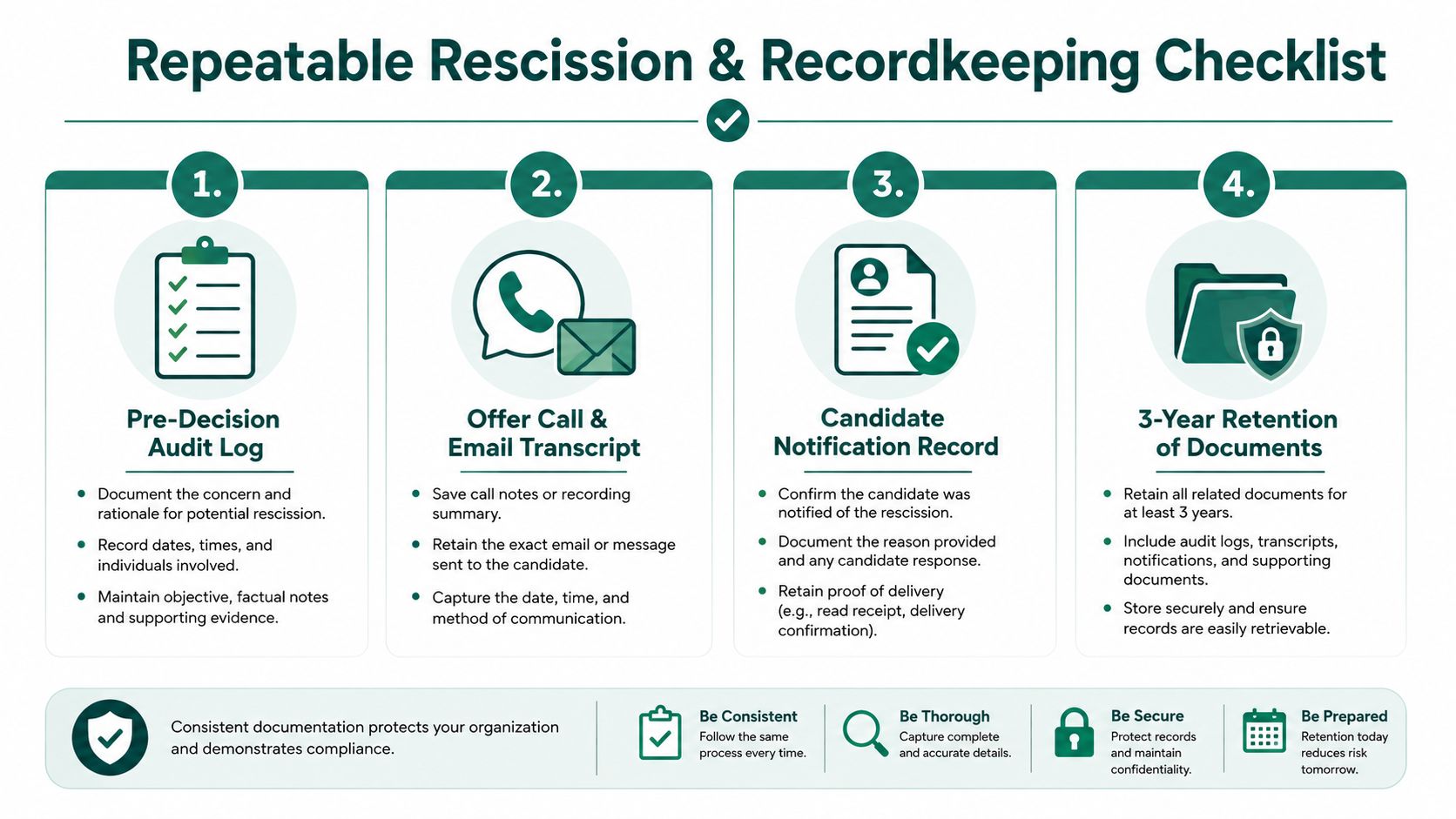
Create one shared case folder for every withdrawal. It should contain:
Retain the original offer and related communications according to the company's legal-hold and record-retention requirements. Don't delete unfavorable drafts, rewrite notes after the fact, or move the discussion to personal messaging accounts.
Should HR contact the candidate again later? Only for a defined business reason, such as a genuine alternative role or an agreed follow-up. Don't use vague promises to soften the conversation.
Should the company give every detail? Give the accurate reason and the relevant process information. Don't disclose confidential information about other employees or speculate beyond the documented basis.
What if the candidate disputes the failed condition? Pause, preserve the record, and follow the applicable challenge or clarification process before finalizing the decision.
Who should make the call? A senior HR or business representative who understands the decision, supported by the appropriate legal or compliance review. The hiring manager shouldn't improvise alone.
Talent Pronto helps employers create more consistent early-stage hiring records through conversational screening, role-specific questions, structured scorecards, and ATS or HRIS integrations. If you want to reduce late surprises and build a more auditable hiring process, visit Talent Pronto to see how the platform can support your team.

Talent Pronto is an AI-powered hiring platform built around Anna, our intelligent AI that conducts 24/7 conversational screening, evaluates candidates against specific job requirements and compliance needs, and schedules interviews. Run everything on the Talent Pronto ATS, our all-in-one applicant tracking system with a branded careers site and Anna built in, or keep your existing ATS and let Anna integrate with Greenhouse, Ashby, iCIMS, Jobvite, Lever, Oracle, and more. Either way, we help organizations reduce time-to-hire and build stronger teams.