Grab a free interview notes template to streamline your hiring process. Includes scorecards, rating scales, and sample questions.
A structured interview has an operational validity of 0.44, compared with 0.33 for an unstructured interview, based on a meta-analysis covering 106 structured samples and 12,847 candidates, versus 39 unstructured samples and 9,330 candidates. The underlying meta-analysis makes the practical point clear: the interview format affects how well an interview predicts later performance.
That's why an interview notes template shouldn't be treated as a place to store impressions after the conversation. It's part of the measurement system. The strongest templates connect questions to competencies, capture evidence before judgment, apply a shared scoring rubric, and preserve a record that recruiters, hiring managers, other interviewers, and compliance reviewers can understand.
Structured notes make candidates comparable. Each person answers questions tied to the same role-critical competencies, while interviewers record evidence against shared criteria. Without that consistency, one interviewer may emphasize communication, another technical depth, and a third personal rapport. The debrief then compares impressions instead of job-related evidence.
The research supports this operating model. Structured interviews produced an operational validity of 0.44, compared with 0.33 for unstructured interviews, according to the meta-analysis of structured and unstructured interviews. Later summaries of the same research line report corrected validity around 0.51 for structured interviews and about 0.38 for unstructured interviews, reinforcing the connection between standardized evaluation and predictive power.
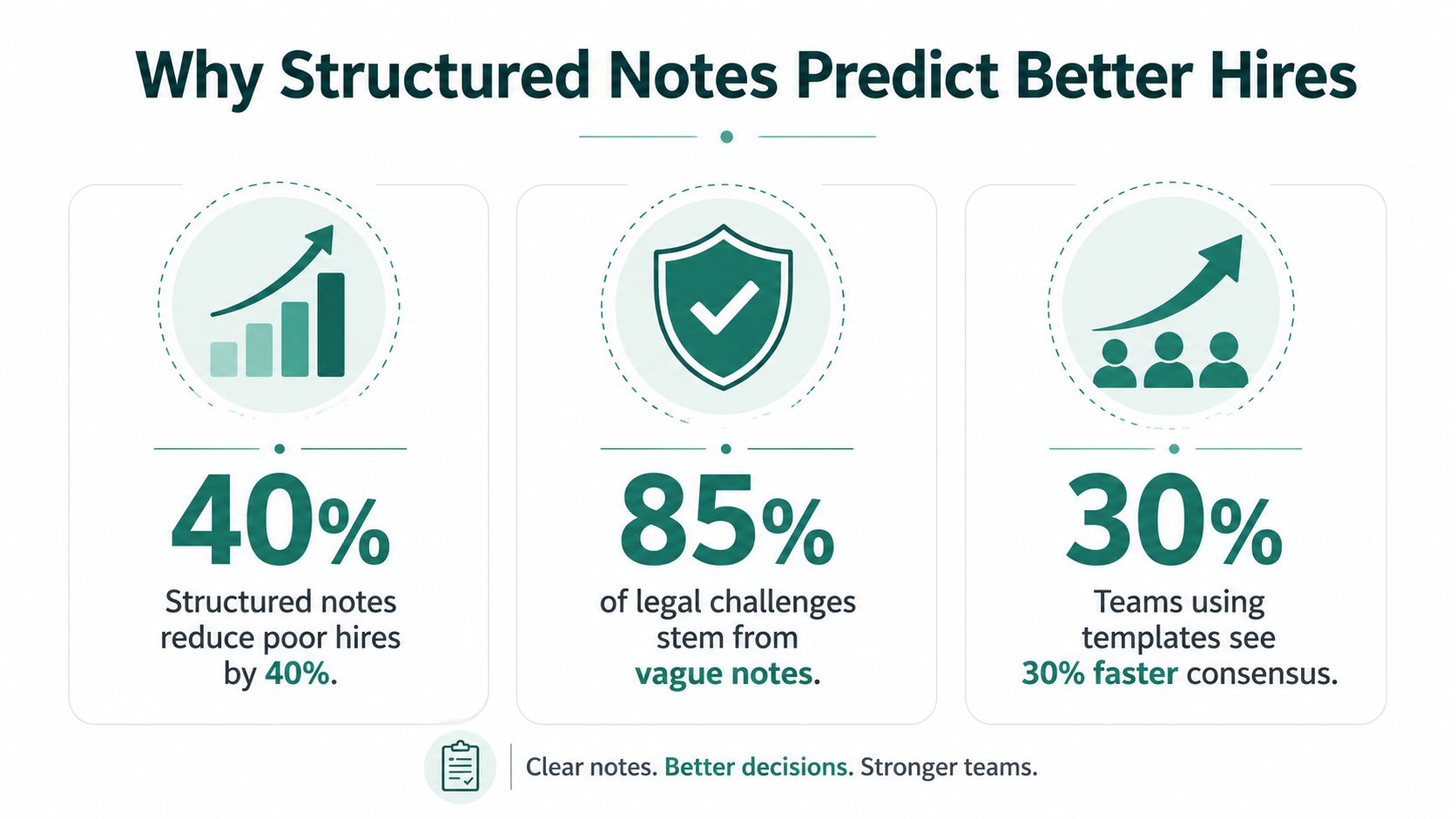
A useful template performs three connected jobs:
A 2023 discussion of structured interviewing identifies it as the highest-validity predictor in a recent meta-analysis and emphasizes that standardized questions and anchored scoring reduce variation between interviewers. The University of Wisconsin Green Bay discussion supports recording competencies, follow-up evidence, and a 1–5 or similar rubric in the same record.
Practical rule: If an interviewer can assign a rating without writing evidence for it, the template is incomplete.
The note does not improve a hiring decision by itself. The operating discipline does. Interviewers must know the assessment criteria before the conversation, record the candidate's answer against those criteria, and complete the rating before personality or a late response reshapes the discussion.
That discipline matters in healthcare and technology hiring, where panels may assess clinical judgment, security awareness, technical problem-solving, collaboration, and leadership within one process. An audit-ready interview notes template assigns each interviewer a defined responsibility and creates a defensible trail from question to recommendation. It also gives recruiting teams a consistent record that can be reviewed, compared, and transferred into an ATS without relying on informal impressions.
Start with a universal skeleton before creating separate versions for screening, behavioral, technical, or panel interviews. The minimum viable template should make a note understandable to someone who wasn't in the room and usable inside the organization's ATS or HRIS.
Record the candidate name, role, requisition context, interviewer name, date, interview stage, and interview type. The note-taker's name matters because calibration requires the team to understand who observed what and whether different interviewers interpreted the rubric consistently. University of Pennsylvania guidance recommends documenting the candidate name, note-taker name, and date, while keeping records factual and avoiding comments about appearance or inferred traits. Its compliant interview-note guidance also treats documentation as material that may be reviewed during an audit or complaint.
List the role-critical competencies and connect each one to its question prompt. Keep the scorecard focused. The interview scorecard guidance from Hire School recommends defining 3–6 role-critical competencies, using a fixed numeric scale, and requiring evidence before a debrief.
For each competency, include:
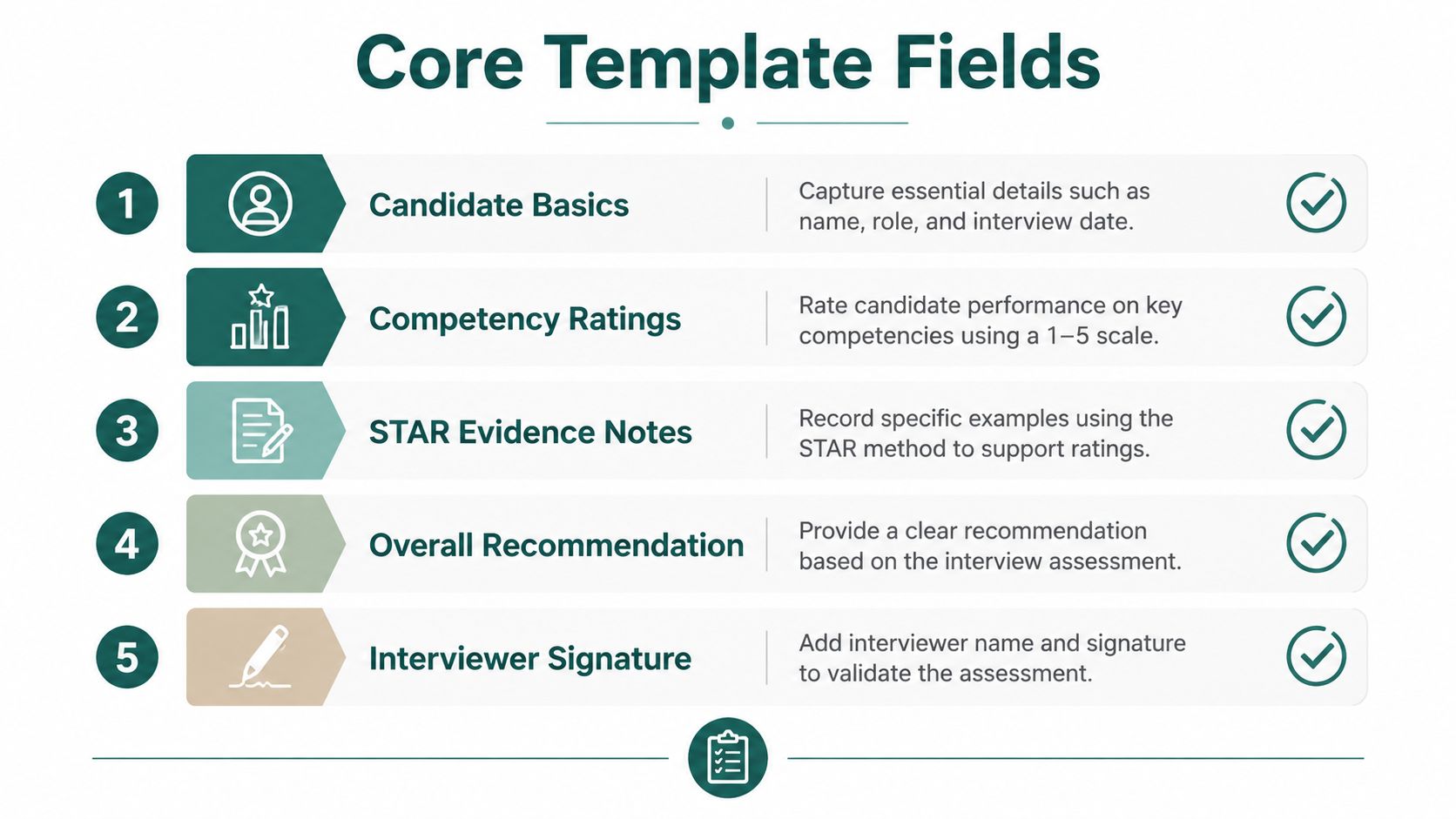
The final area should include the overall recommendation, the strongest supporting evidence, unresolved concerns, required follow-ups, and confidence in the recommendation. Confidence isn't a substitute for a rating. It tells the debrief group whether the interviewer had enough evidence or whether a missing answer needs another probe.
Michigan's guidance recommends documenting interview questions, rating tools, selection criteria, narrative assessments, recommendations, and specific reasons for recommendations. It also notes that access to notes attached to a job opening is limited to relevant hiring participants, such as the opening creator, approvers, and additional hiring team members. The Michigan interview-note guidance illustrates why permissions and field design belong in the template conversation, not as an afterthought.
A short screening call shouldn't require the same documentation as a final leadership panel. The right interview notes template captures enough evidence for the decision without turning every interaction into a transcription exercise.
| Template Type | Best For | Key Fields | Typical Duration |
|---|---|---|---|
| General screening | Early qualification and high-volume roles | Eligibility, motivation, relevant experience, logistics, recommendation | Short |
| Behavioral deep-dive | Mid-level and senior roles | Competency, question, STAR evidence, follow-up, rating | Moderate |
| Technical assessment | Engineering, data, security, and specialist roles | Problem approach, assumptions, artifacts, correctness, trade-offs, rating | Moderate to extended |
| Role-specific evaluation | Healthcare, leadership, regulated, or specialized positions | Job-family competencies, scenario evidence, risk flags, confidence, recommendation | Variable |
Use this when the recruiter needs to establish basic fit and decide whether the candidate should move forward.
Keep this format lean. A screening template overloaded with every competency in the final scorecard slows the recruiter and produces incomplete fields.
Use a competency-by-competency table for interviews focused on past behavior:
| Competency | Question | Situation | Task | Action | Result | Score |
|---|---|---|---|---|---|---|
| Leadership | Tell me about a time you led a difficult project. | Context | Responsibility | Candidate's actions | Outcome and learning | 1–5 |
| Problem-solving | Describe a problem you solved with limited information. | Context | Challenge | Reasoning and steps | Outcome | 1–5 |
| Collaboration | Give an example of working through conflict. | Context | Candidate's role | Behaviors used | Resolution | 1–5 |
Technical interviews need room for assumptions, reasoning, artifacts, and trade-offs. Capture whether the candidate clarified the problem, selected an appropriate approach, tested the result, and explained limitations. For a coding exercise, include links or identifiers for permitted artifacts, reviewer comments, and whether the candidate's solution met the predefined requirements.
For a clinical, operational, leadership, or regulated role, use scenario-based questions tied to actual job demands. Add fields for risk judgment, escalation behavior, documentation discipline, stakeholder communication, and any required credential or eligibility check. Don't add fields merely because they sound thorough. Every field should support a decision, a calibration conversation, or an audit trail.
A template cannot compensate for a note such as “strong communicator” paired with a high score. Interviewers need a consistent method for capturing evidence, then must apply the rubric to what the candidate demonstrated. That sequence produces notes another interviewer can review, calibrate, and transfer into an ATS without guessing.
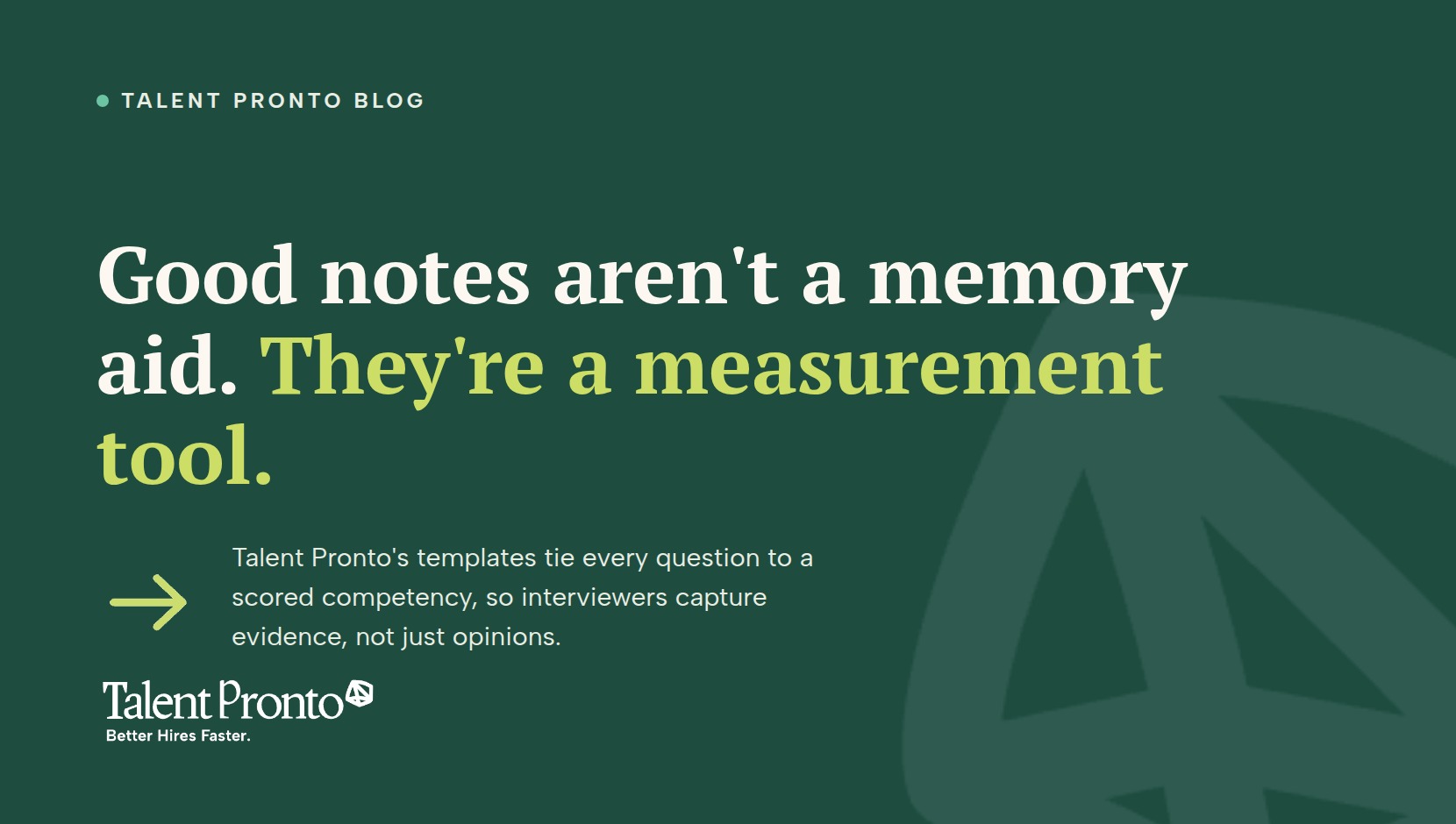
The STAR method gives behavioral answers a usable structure. The interview notes guide from Pin recommends preparing the template before the interview, mapping each competency to 1–2 questions, setting the rubric in advance, and recording the Situation, Task, Action, and Result.
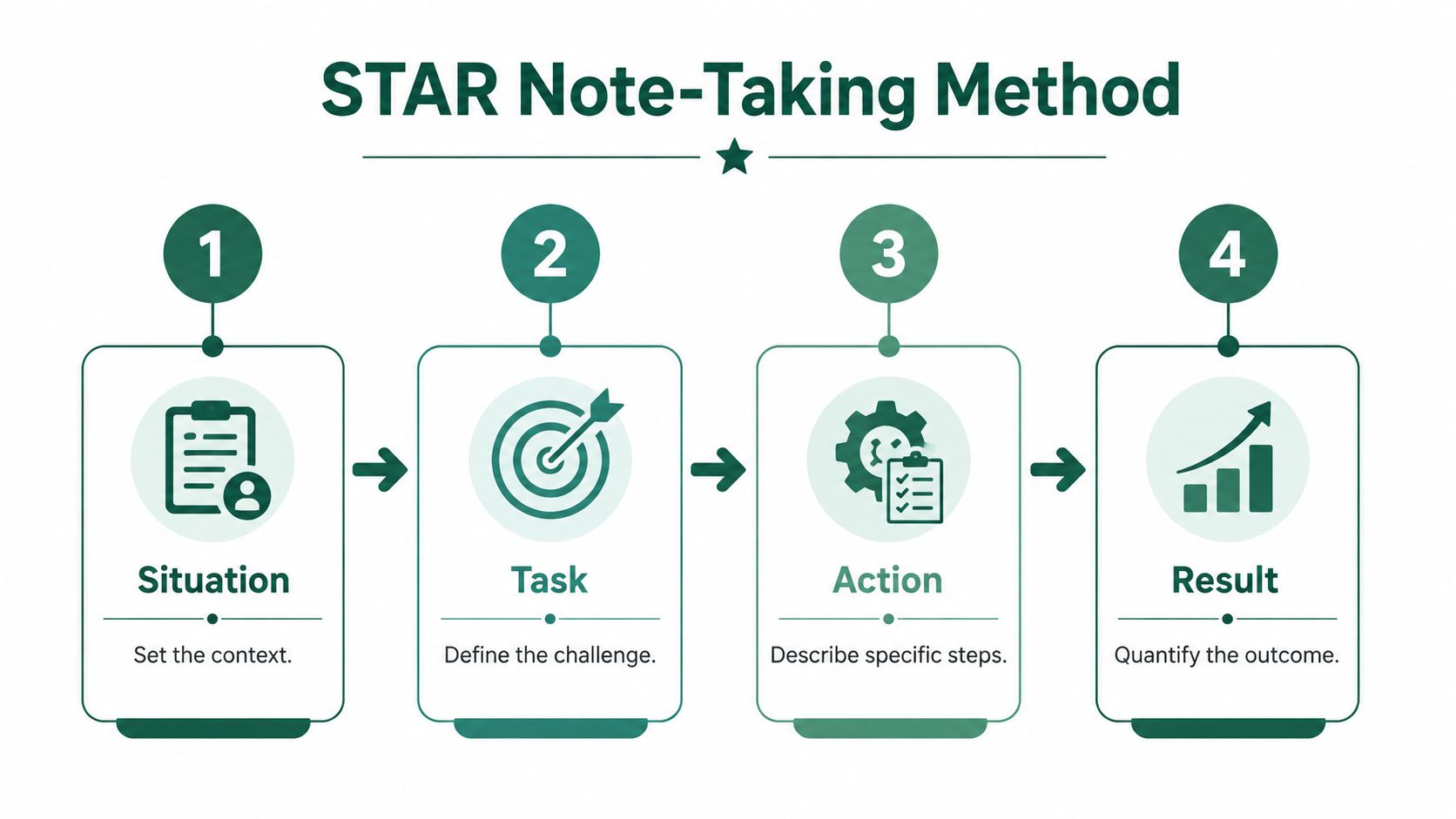
Use shorthand while the candidate answers, then complete the evidence field before selecting a score. Writing the rating first can pull the notes toward confirmation. Recording the evidence first makes the entry easier to audit and keeps the decision tied to the interview response.
A weak entry looks like this:
“Good leadership example. Confident and thoughtful. Seems like a strong fit.”
It records conclusions, not evidence. A stronger entry might read:
Situation: Regional clinic implementation was behind schedule. Task: Candidate owned coordination across operations and IT. Action: Replanned milestones, created a risk log, and escalated a vendor dependency. Result: Described restoring the launch plan and establishing a weekly issue review.
Another interviewer can assess that entry against the same leadership anchors. The format also distinguishes the candidate's actions from the interviewer's personal reaction, which supports consistent debriefs and cleaner ATS records.
Follow-up questions should fill an evidence gap rather than turn the interview into an improvised conversation. Useful probes include:
Score each competency immediately after its question or evidence set. Define what a low, acceptable, strong, or exceptional answer means before the interview starts. A 1–5 scale then measures performance against agreed anchors instead of ranking interviewer preference.
Research on note quality adds a useful caution. A study of 7,650 candidates found that the number of job-related capabilities mentioned in post-interview notes was positively associated with job performance and promotions, and negatively associated with turnover. The research also found that note-taking improved recall accuracy without necessarily improving judgment accuracy. As discussed in the National Library of Medicine study on note quality, structured fields and anchored scoring still matter because complete notes alone do not guarantee consistent decisions.
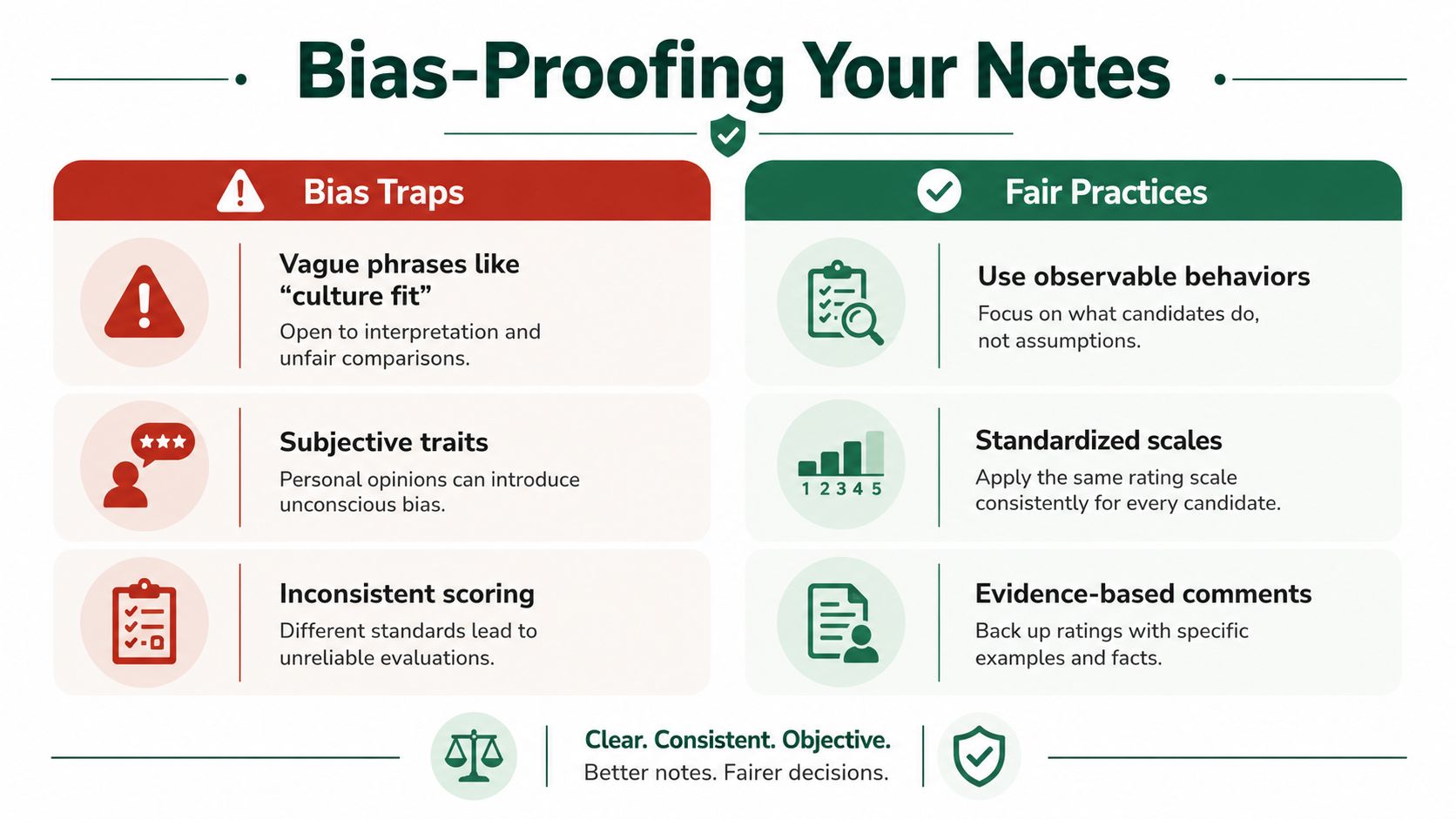
“Culture fit” and “seemed unsure” may be quick to write, but they are weak records. Neither phrase identifies a job-related behavior, and both can conceal a personal reaction that other interviewers cannot test or calibrate. The interview bias guide provides useful context. The template must turn that awareness into consistent evidence.
Replace subjective labels with the question asked, the candidate's answer, the observable behavior, and the competency affected. That structure makes notes easier to audit and gives an ATS usable fields instead of impression-based commentary.
Use this pattern when documenting a concern:
For example, replace “lacks confidence” with: “When asked to explain the incident response process, the candidate described the team's actions but could not identify their own responsibility after a follow-up prompt.” This note may support a concern about ownership or technical communication. It does not convert demeanor into a qualification.
Compensation discussions require the same discipline. Record the topic discussed, the candidate's stated expectations, and any agreed next step. Do not speculate about financial circumstances, family obligations, or motivation. Those comments create compliance risk and do not support a job-related decision.
Hiring rules vary by jurisdiction, but a durable standard applies across job families: document job-related facts, avoid protected characteristics, and preserve the connection between evidence and criteria. University of Pennsylvania guidance specifically warns against comments about physical appearance and inferred traits such as pregnancy or lack of ability.
As noted earlier, the same National Library of Medicine study found that interviewer notes can reduce the effect of negative expectations on overall impressions, although they do not remove bias from every rating dimension. Structured fields help because they require the interviewer to show what supports each rating. They also create a clearer record for debriefs, audits, and later review.
A note that stays in a notebook, private document, or email thread can't reliably support a debrief or an audit. The template should map directly to the fields the hiring team uses in its ATS or HRIS, including the candidate, requisition, interview stage, competency, evidence, rating, recommendation, and interviewer identity.
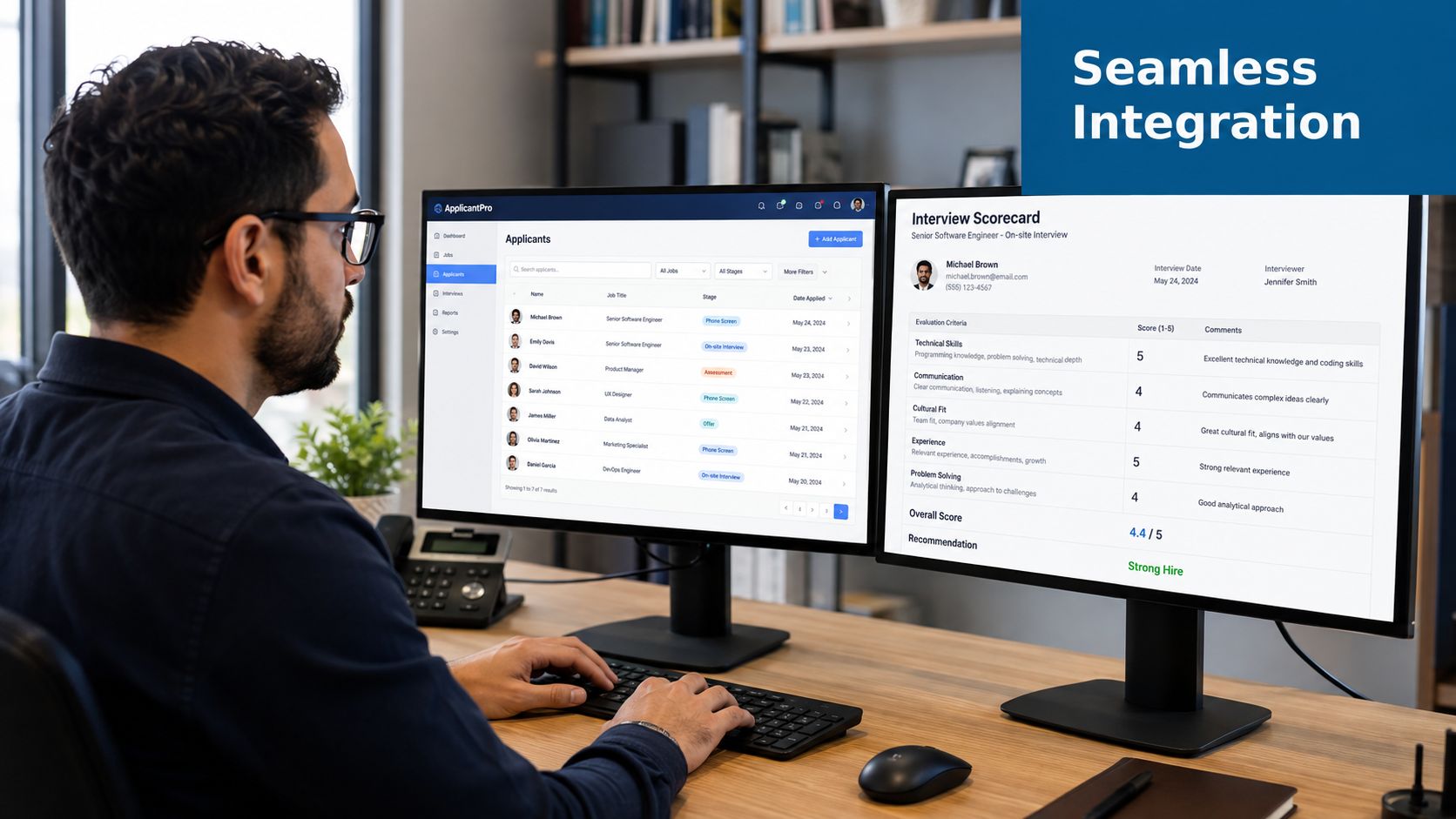
Greenhouse, iCIMS, and Workday may use different field names and workflows, but the underlying data model should remain stable. Map each role competency to a scorecard field, preserve the evidence note alongside the rating, and make the recommendation traceable to the completed evaluation.
Avoid a single free-text box called “interview feedback.” It may be easy to complete, but it creates inconsistent records and makes aggregation difficult. Separate fields let the recruiter identify missing evidence, let the hiring manager compare interviewers, and let compliance reviewers understand how the decision was reached.
AI-assisted screening adds another requirement. If a system generates structured evaluations, human interviewers should be able to see the evidence behind the evaluation, add follow-up questions, record uncertainty, and distinguish automated output from human assessment. Talent Pronto, for example, uses an AI interviewer to conduct conversational screening and prepare structured scorecards against role-specific criteria. It should be treated as one input into the employer's process, not as the final hiring decision.
The ATS remains the system of record. A structured note is valuable only when the right people can access it under the organization's permissions and retention practices.
The workflow also needs a human review point. Before a recommendation is finalized, the interviewer should confirm that the summary accurately reflects the conversation, that every rating has supporting evidence, and that no protected or irrelevant information has entered the record.
Teams evaluating their broader people-data architecture can also review HRIS integration considerations, especially where candidate status, interview feedback, and scorecard data need to move between systems without duplicate entry.
Rollout works best when the team pilots the template on one hiring cycle rather than launching a perfect-looking form everywhere. In the first week, choose the competencies, write the anchors, map questions, and test whether an interviewer can complete the form without losing focus.
In the second week, run a calibration session. Have interviewers score the same sample responses, compare the evidence they captured, and remove fields that produce repetition. Then use interviewer training guidance to reinforce objective notes, probing, scoring, and debrief behavior.
During the first month, review completion quality rather than completion rates. Look for inflated ratings, missing STAR elements, unsupported recommendations, and comments that describe personality instead of job-related behavior.
Adoption test: If interviewers skip a field repeatedly, decide whether the field is essential, poorly explained, or unnecessary.
Access should be limited to people directly involved in the hiring decision, with the ATS or HRIS serving as the controlled record. Keep the process fast enough for real workloads, but don't remove the evidence fields that make the evaluation defensible.
Talent Pronto helps employers conduct conversational screening, ask role-specific behavioral and technical questions, and produce structured scorecards that align with hiring criteria. Visit Talent Pronto to see how structured candidate evaluations and ATS/HRIS integrations can support a more consistent, audit-ready hiring workflow.

Talent Pronto is an AI-powered hiring platform built around Anna, our intelligent AI that conducts 24/7 conversational screening, evaluates candidates against specific job requirements and compliance needs, and schedules interviews. Run everything on the Talent Pronto ATS, our all-in-one applicant tracking system with a branded careers site and Anna built in, or keep your existing ATS and let Anna integrate with Greenhouse, Ashby, iCIMS, Jobvite, Lever, Oracle, and more. Either way, we help organizations reduce time-to-hire and build stronger teams.